
Lights Out at the Regal
Nettlecombe had not had a murder in living memory, which was precisely the trouble, because it meant that when one finally arrived nobody recognised it, and they very nearly let it go out with the milk.
Pearl Tibbets recognised it. But then Pearl Tibbets noticed a great many things the village didn't credit her with noticing, on account of her being, in the general estimation, only the sign lady — the small round widow from the workshop on Forge Lane who could bend a length of glass tube over a flame and fill it with gas until it glowed, and who had, in consequence, spent forty years being talked over at parish meetings by people who couldn't have wired a doorbell.
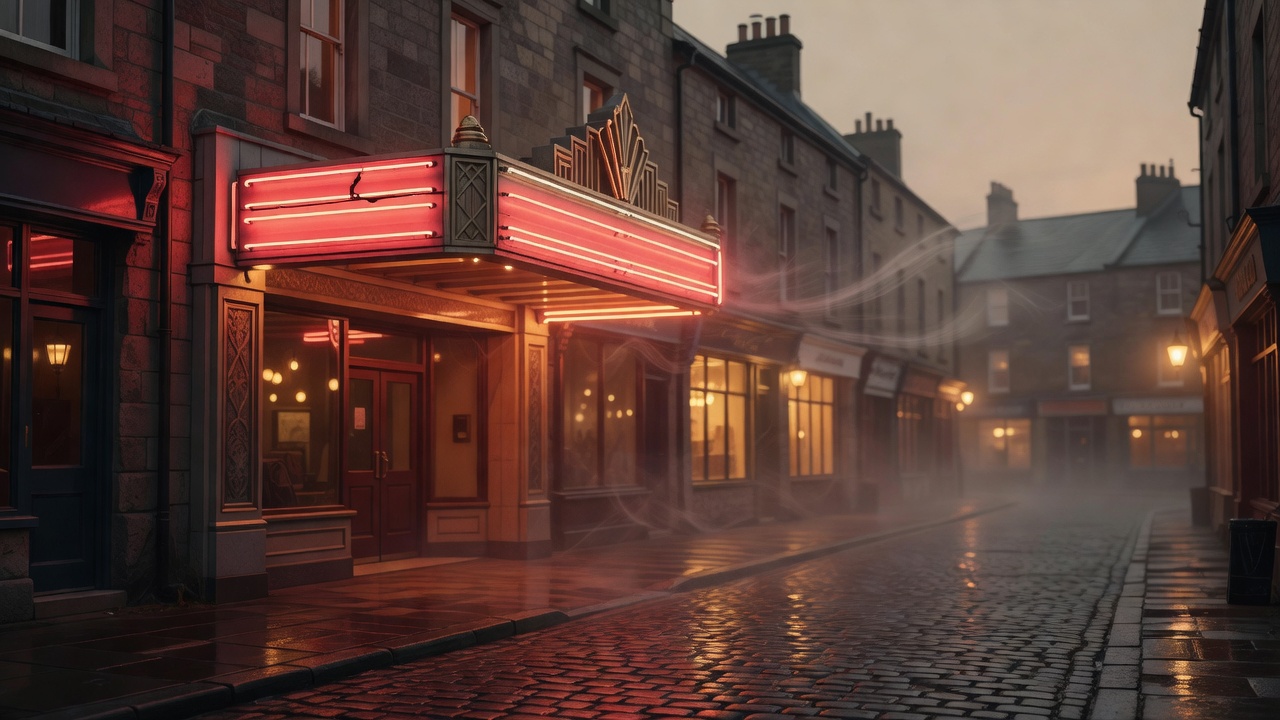
It was the sign that had her up at the Regal so early, the morning after the grand reopening. One letter had let her down. All through the gala the night before — the bunting, the speeches, Gerald Frostick in a velvet jacket cutting a ribbon with scissors too small for the job — the whole marquee had blazed out over the high street in Pearl's good warm red, THE REGAL, every letter perfect, except that the final L had refused to strike. A duff electrode; it happened. So the sign had shone THE REGA into the autumn dark, and Pearl had gone home pink with mortification and promised herself she'd be up with the larks to put it right before the village had its morning laugh.
She had let herself in through the side door with the key Gerald had given her, and she had found him at the bottom of the projection-box stairs, quite tidy, quite cold, one carpet slipper still on.
The stairs to the projection box were steep as a ship's ladder and twice as mean, and everyone in Nettlecombe had said for years that they'd be the death of somebody. So when young Detective Sergeant Okafor arrived from Barnstaple and looked at the stairs and looked at the slipper and wrote misadventure in his neat little book, nobody was inclined to argue, least of all Bramley Frostick, the dead man's cousin and partner in the venture, who had gone the colour of a dishcloth and kept saying what a tragedy, what a terrible tragedy, and might they all go home now.
"He came up to fix his own lamp, I shouldn't wonder," said the Sergeant, not unkindly, to Pearl, who was hovering. "Tripped in the dark. These old places." He had already decided she was a witness of the trembling-old-lady sort, to be got a cup of tea and got rid of. "You found him, my love. Nasty shock. You sit down."
"He wasn't fixing his lamp," said Pearl.
"No?"
"Gerald Frostick wouldn't have known which end of a lamp to fix. That was Maurice's department, the projection. Gerald did the velvet jackets." She said it without malice. "And he'd not have gone up those stairs in his slippers in the dark for the pleasure of it. There's a switch at the bottom. He'd have put the light on."
The Sergeant smiled the smile of a man being patient, and didn't write it down, and so Pearl, who had learned long ago that the quickest way past a closed door wasn't to knock on it, said no more, and went and put the kettle on in the little foyer kitchenette, and listened.
She made tea for everyone, because a woman with a teapot is invisible, and an invisible woman hears a great deal. And what she heard, that long morning, all pointed the one way, which was towards money.
It was Bramley who pointed it loudest, though he didn't mean to. Bramley kept the accounts, and Bramley wanted the place shut up and sealed and the reopening "postponed indefinitely, in the circumstances" — an odd haste in a man who had spent two years getting the Regal open — and Bramley's eyes kept going to the little office off the foyer and then going away from it again, quickly, the way your tongue goes to a sore tooth and thinks better of it. By eleven the village had the rest of it, the way the village always did, passed along with the milk: that there had been a man down from Exeter twice this autumn, a man in a good coat with a folder, a development man; that the lovely restoration had never been meant to last, that Gerald had been going to sell the Regal out from under them the moment the Gazette had its bunting photographs, and put nine flats where the circle was. And — this from Della, who had been clearing glasses near the office at the end of the gala — that Gerald and Bramley had been heard going at it hammer and tongs after the speeches, low and vicious, something about the figures and where's it gone, Bram, before the doors were shut.
So there it was, laid out neat as a cold supper: a man about to betray his whole village for a developer's money, and a partner with his hand in the till, and a row in the dark. Pearl turned it over while she warmed the pot. It made a great deal of sense. It made, she thought, rather too much sense, the way the loud answer always did — but it was a powerful loud answer, and by noon she had as good as decided it herself, and had said enough of it, gently, to Sergeant Okafor that the young man had stopped talking about lamps and gone to stand a long time in the doorway of that little office, looking at the locked drawer of it with a new sort of interest.
She took tea, in between, to the two who weren't Bramley, because a fair mind takes tea to everyone.
She took it to Della Mott, who ran the café two doors down and had done the catering, and who had had public words with Gerald the week before about the lease on the café, which Gerald had lately and unaccountably declined to renew — another little debt in the ledger against the dead man. But Della wasn't weeping about leases. "You'll think me a foolish old thing," she said. "It's only — I used to come in here, evenings, this last year. Before it opened proper. Gerald gave me a key for the catering and I never gave it back. I'd let myself in and sit in the dark in the big room where the screen is, and just sit. Since my Ron." Pearl sat with her a moment, and crossed her off a list she hadn't quite admitted she was keeping. A woman who came to grieve in an empty cinema wasn't a woman who pushed people down stairs. That was a pearly sort of secret, the soft kind everyone carried. It was the scarlet ones the morning was full of.
And she took tea, last, up the dreadful stairs to the projection box, where Maurice Penhale had shut himself in with his machines.
Maurice had run the pictures at the Regal for forty-one years, man and boy, through the carbon-arc days when you fed the lamp by hand and the whole box smelled of burning and magic. He was seventy now, and stooped, and he loved that box the way some men love a boat. And Gerald Frostick had been going to take it from him — had bought a digital projector, a thing the size of a microwave that ran off a memory stick, and told Maurice, kindly, in the velvet way, that there would always be "a place for him front of house." Front of house. Tearing tickets, for the man who had threaded the light through that room for forty-one years.
But Maurice wasn't a scarlet secret. Maurice was an old man losing his life's work, and the village had a dozen of those, and none of them had ever hurt a fly; and besides, the loud answer was downstairs in the little office with its drawer locked, and Pearl's mind was three-quarters made up. She only went up out of fairness, and to be kind, and because the tea would go cold else.
Maurice took the cup with both hands. He didn't look at her.
"Terrible thing," he said.
"Terrible," Pearl agreed, and let him talk, because grief likes a listener, and he talked about the carbon-arc days, and then, unbidden, about the night before. "Wasn't down for the speeches," he said. "Never one for crowds. I kept up here with my machines, and went home the back way after, and left them to it." He turned the cup in his hands. "Saw the front lit up lovely as I went, mind. Walked round to look at it. Half-twelve, near enough, on my way home — the whole sign blazing away over the street, red as anything, THE REGAL, every letter. Beautiful job you did, Pearl. I stood and looked a good while. Last nice thing, that was, before all this."
"That's kind of you to say," said Pearl.
And she went very still inside, the way she did, the way she went still over a faulty transformer, when the fault is suddenly not where you have been looking for it all morning but somewhere else, somewhere quiet, somewhere it has been sitting in plain sight the whole while.
Because Maurice Penhale had just told her a thing that couldn't be true. Two things, in fact, and the loud answer downstairs went quiet in her head all at once, the way a wireless goes quiet when you finally hear the small sound under it.
The trouble with what Maurice had said was the sign.
The Regal's new marquee did not blaze all night. Pearl had seen to that herself, and had been rather proud of it, and had said so to anyone who would stand still — to Gerald, to the man from the Gazette, to half the gala — because it was the clever modern part of an old-fashioned job. The sign was on a timer. It came up at dusk on its own and went off at midnight on the dot, every night, click, dark. "Saves Gerald a fortune in the electric," she had told them, beaming, "and saves my tubes besides — neon's like the rest of us, it lasts longer if you let it rest." She had stood in her own cottage window at midnight the night before, brushing out her hair, and watched THE REGA wink out over the rooftops dead on twelve, and been cross all over again about the L.
So at half-past midnight there had been no lit sign for Maurice to admire, because at half-past midnight there had been no lit sign at all — the timer had taken it dark half an hour before, the whole high street with it. That alone undid him. But underneath it sat the smaller thing, the sharper one, and it was the L. He had said every letter, THE REGAL, perfect, red as anything — and the L hadn't struck once all night, dead in its tube since the gala, the very letter the whole parish had laughed at. He hadn't seen a lit L because there had never been a lit L to see, not at half-twelve, not at any hour. The timer caught him on the clock. The broken letter caught him on the word. Either alone would have done; he had contrived to hand her both.
Which meant Maurice hadn't ambled home past a beautiful lit sign at all. He had built her a half-twelve and a blazing marquee to stand himself under, an old man admiring her handiwork, long after the thing was done — and in building it he had reached, the way liars do, for the sign as it was meant to be, whole and perfect, every letter of it, not as it had actually shamed her that night; because of course the sign was on and entire, a cinema sign was always on, it had been every night of his forty-one years. He had been up in his box during the speeches, alone with his machines, while Pearl was downstairs telling the whole village the new sign went dark at midnight. The one fact in Nettlecombe that would catch him was the one fact he hadn't come down to hear.
And the loud answer — the developer, the cooked books, the row in the dark — was true, every word of it, Pearl didn't doubt; but it was the wrong crime. Bramley had been robbing his cousin, and Gerald had been robbing the village, and all of that was real and would have to be answered for. None of it had pushed a man down the stairs in his slippers. That had been quiet, and small, and done by the only person in the building nobody had thought to suspect, for the oldest reason there was, which wasn't money at all.
She didn't go straight to the Sergeant. The Sergeant had decided she was the trembling-old-lady sort, and a closed door is a closed door, and a thing shown is worth ten things said. So she waited until the afternoon, when he was preparing to release the building with misadventure still tidy in his book and the locked office drawer earmarked for the fraud squad, and she asked him, very meekly, whether before he went he might help her with the sign, as it would take two, and it would be a shame to leave the village laughing at that L another night.
He came, to humour her. They stood under the marquee in the failing afternoon and Pearl showed him the little grey box on the wall where the wires went in.
"It's on a timer, see. My doing. Comes on at dusk, goes off at midnight, every night, regular as the church clock — half the parish watched it go dark on the hour last night, and I did too, from my own window." She let that sit. "So I've wondered all day, Sergeant, how Maurice Penhale stood here at half-past twelve and admired the whole sign blazing. There was nothing to admire; it had been off half an hour. And even had it been lit, he'd have been one letter short — for that L hasn't struck since the gala, dead in its socket, the one the parish laughed at." She looked up at the cold red tubes. "He saw a letter that wasn't there, on a sign that wasn't lit. That takes some doing, for a man who was only walking home."
Sergeant Okafor opened his neat little book, and didn't write anything in it, and looked at the steep stairs through the open doors, and then he looked at Pearl Tibbets, the sign lady, in quite a new way.
"You had me on the cousin," he said slowly. "The accounts."
"I had myself on the cousin," said Pearl. "We all did. There's a great deal wrong in that office, and you were right to look, and the fraud people will have a lovely time. But a man can be a thief and not a murderer, the same evening, in the same building. Bramley was downstairs robbing the till. It was Maurice who went up." She sighed. "I don't think he meant it, if it helps. I think he went up to ask Gerald, man to man, to let him keep his box, and Gerald laughed the velvet laugh and turned to go up those wicked stairs, and Maurice put out a hand — only to turn him round, I should think, only to make him look — and nobody was ever steady on those stairs. He'd have got clean away with it, too. The stairs would have taken the blame. He oughtn't to have told me about the sign."
Maurice didn't deny it, in the end. He hadn't the lie in him for a second go; that was rather the point of Maurice. He set down his cup and looked at his own hands as though they belonged to someone he was disappointed in, and said yes, and told it much as Pearl had — the asking, the velvet laugh, the hand put out, the long terrible quiet afterward in which he had walked home and lain awake building the one wall he thought would keep him safe: that he had passed by late and innocent under a beautiful blazing sign. He had built it on the one thing a man of forty-one years in a picture house was sure of. That the lights are always on.
Bramley went off to answer for the figures, which served him right; and the village, finding it had nearly lost the Regal twice in one night — once to a developer and once to grief — discovered it had no intention of losing it at all. They were gentle, in the end, about Maurice, who had given the place forty-one years and taken one terrible minute back.
And on the evening they opened the doors again, Pearl Tibbets climbed a ladder she was really too round to be climbing, with a fresh length of glass she had bent that afternoon over the flame on Forge Lane, and set the new L into its place — the letter that had shamed her at the gala and, in the end, hanged a man, for he had sworn he saw it lit on the one night it never shone. She thought of Maurice while she fitted it. He had loved the light in that building for forty-one years and trusted it the way you trust a thing that has never once let you down, and it had caught him at the last, on the single night it went dark. There was no satisfaction in it. There rarely was.
She came down and crossed the road to stand on her own, the way she liked, where she could see the whole of it. At dusk the timer did its quiet work, click, all by itself, and the tubes warmed and caught and steadied, one letter after another, until the whole of it hung over the high street in her good warm red, every letter perfect, the L and all the rest. THE REGAL.
It would go off at midnight, on the dot. It always would — that was the trouble, and the mercy, and the whole of the case, in five red letters. But it was a long way from midnight yet. The light lay down across the wet street like something poured, and the village stood in it, and somebody pressed a cup of tea into Pearl's hands without being asked — which was, she thought, about the nicest thing one person can do for another — and she drank it, and looked up at her sign, the sign lady, and let them all not notice her, and was content.
Enjoyed this story?
Read next
 Nettlecombe had buried Walter Crockaway under a record marrow before, in a manner of speaking, every August for nine years; this August it buried him in earnest, and the whole village agreed at once that it must have been Sidney Pyne, because that was the loud answer, and the loud answer is so very restful.
The Prize Marrow
 A torch singer hired me to find her kid sister, and I found her, which is the part of this work nobody warns you can be the cruelest thing you do all year.
The Number That Was Never Called
 There were nine setters at the centenary table, and only one of them could have written the last clue in the dead man's grid — because only one of them already knew how the evening would end.