
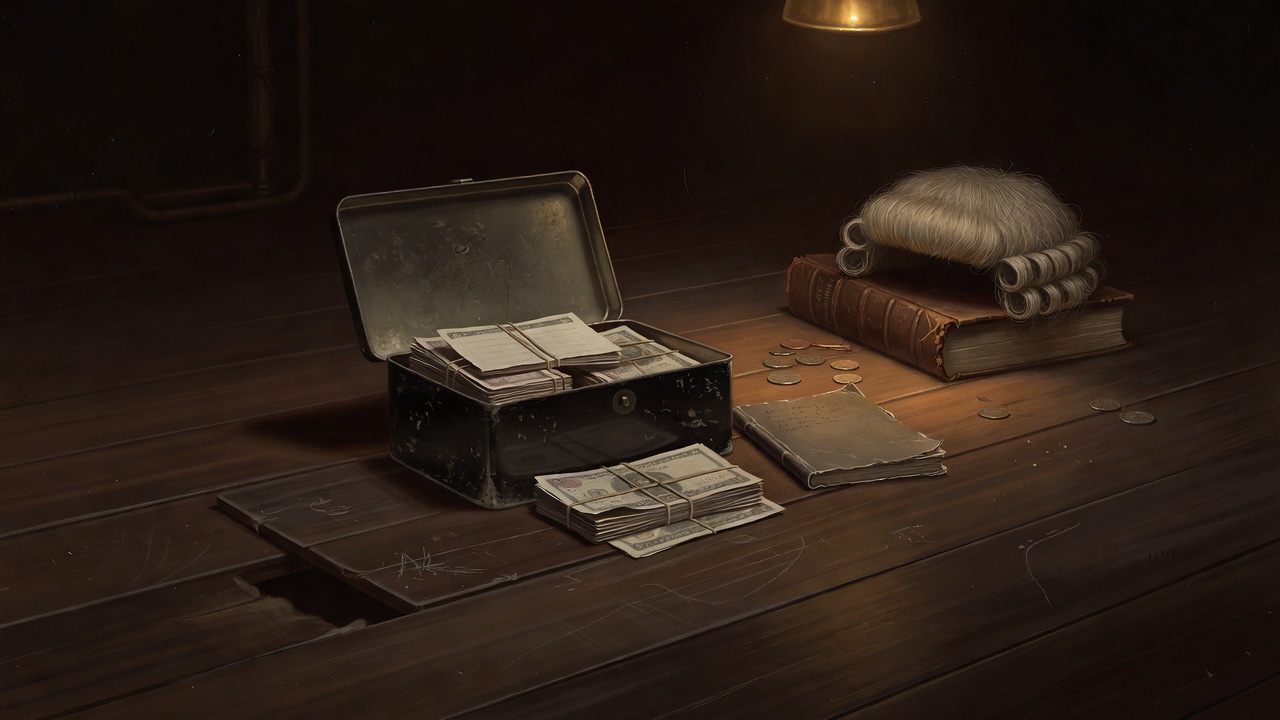
The Burial Fund
Content notes
mild language, alcohol, dementia
I have defended the Cobbs across three generations, on charges ranging from the receiving of dubiously-provenanced televisions to an affray outside a christening which I still maintain was a misunderstanding about a buffet, and in all that time I had never once been ashamed of them, which is more than I can say for the Bar, the Bench, or my own family, and a very great deal more than I can say for myself.
I begin with the shame because the shame is the whole of the case, and a casebook, unlike a conscience, may be opened at whatever page best serves the telling. The charge, when it came, was theft, which is a Cobb sort of charge and ought to have presented no novelty whatever. The Cobbs and theft are old companions; they have grown grey together; I have stood between them and the consequences so often that I could conduct the defence in my sleep and frequently suspect I have. But this theft was different. This theft had a quality I had not met in forty years of Cobbs, and it took me some little while to give it a name, and the name, when I found it, was shame — not the law's shame, which is merely a verdict, but the family's, which is a wound — and it was the first Cobb case in my life that the Cobbs themselves did not want me to win.
For the thing a Cobb was charged with stealing was the burial fund. And there is, in the particular acre of South London from which the Cobbs spring, no lower thing a man can take.
I should explain the burial fund, since it is the heart of the matter and the young will not have heard of such an institution, the young having arranged, with the confidence of people who intend to live forever, never to die at all. In the days when men worked the docks — the real docks, the ones that are now apartments with names like Wharfside and The Granary, sold to people who have never lifted anything heavier than an opinion — the men who worked them banded together against the one certainty that the rest of life leaves a working man no margin to insure against, which is the certainty of his own funeral. They paid in. A few pence a week, then a few shillings, then a few pounds, into a tin, kept by one of their number, against the day each of them would need a decent box and a decent hole and a decent number of men in dark suits to stand round it and lie about him kindly. The Bermondsey and Rotherhithe Stevedores' Friendly Society, it was called, and it had been called that for a hundred and forty years, and it still existed, after a fashion, in a clubroom up a stair off a street that the river had long since stopped having any business with, kept going by perhaps a dozen survivors with an average age north of eighty and an average opinion of the modern world somewhere south of mine.
And the burial fund — the tin, the actual tin, the thing the few pences had gone into for a century and more — had been found empty. And a Cobb had been found with the money.
Sefton brought me the brief in the manner of a man delivering a death in the family, which, as it turned out, was nearer the mark than either of us then knew.
Sefton is my senior clerk. He is a long, grey, funereal man who has the bearing of an undertaker between engagements and the soul of a Victorian almoner who died disappointed in the deserving poor, and he keeps my diary, my fees, and the small portion of my dignity that the years have left in his custody. He does not approve of me. He has never approved of me. It is the warm and constant weather of our association, and I should be lost without it, as a man is lost without the climate he was raised in.
"It's a Cobb, sir," he said, and set the papers on my desk with the particular gentleness he reserves for briefs that grieve him, which are not the same as the briefs that fail to pay.
"It usually is, Sefton. Which one? If it's young Terence and the scaffolding again I shall want a sandwich first."
"It's the boy, sir. Danny. Wally's grandson." He let that settle, which is a thing Sefton does, the settling, the way other men lay a hand on your arm. "Albert's line. The stevedore. You'll remember Albert."
I remembered Albert. I had never met Albert Cobb, who died before I was called, but I had held, not so very long ago, in a courtroom, an object engraved with his name, and the holding of it had won a case I am not at liberty to retail, the particulars belonging to a widow who trusted me and to the dead, who are the most discreet of all my clients. Albert Cobb had been a stevedore on that very river, a man who broke his back on the docks for forty years and was given, at the end of it, the only good thing the family had ever honestly come by. His son Stanley I had buried, more or less, having defended him for thirty years and grown fond of him in the way one grows fond of weather one has stopped fighting. And Stanley had a brother, the second of Albert's sons, a younger and a quieter one, and his name was Wally, and Wally Cobb was, as far as I knew, still alive, which at the Cobb actuarial rate is a distinction in itself.
"Wally's grandson," I said. "Then he's — what?"
"Nineteen, sir." Sefton's face did the thing it does perhaps three times a year, the thing I have learned to watch for the way a sailor watches the glass: it became, briefly and against every principle the man holds dear, the face of a person with a heart somewhere about him. "Nineteen. And they've got him with the money, sir. Caught cold with a roll of it in his coat, near as makes no difference to the tin itself. Burglary and theft, the whole fund — the Stevedores' burial fund, three thousand-odd pounds gone in all, which doesn't sound much, only —"
"Only it's a hundred and forty years of pences," I said, "and the box of every old man who put them in, and it is, in that postcode, the one thing you do not take. Yes. I understand the only, Sefton. What does the boy say?"
And here Sefton looked at me with an expression I had not seen on him in thirty years, an expression of pure professional bafflement, the look of a clerk who has met a thing his ledgers have no column for.
"That's it, sir," he said. "That's the whole of it. He says nothing. Not a word. Not to the police, not to the solicitors, not to his own family. He's pleaded not guilty and then closed up like a grave. Hartley Grace can't get a syllable out of him. And the family —" he paused. "The family don't want you on it, sir. That's the part. They sent word. Maureen sent word, Stanley's Maureen, you'll recall her. She said —" and Sefton, who has a memory for the awkward like a hook for the coat, produced it exactly — "she said, Tell Mr Fenwick we're ever so grateful, and tell him the boy's pleading guilty in the end, and tell him to leave it. Word for word, sir. Tell him to leave it."
I sat for a moment with that, turning it over the way you turn a coin you suspect of being counterfeit. In forty years no Cobb had ever told me to leave it. The Cobbs are not, taken in the round, a clever family, but they are a loyal one, and loyalty had always, in my experience, run towards me, the family clinging to old Fenwick as the one fixed point in a hostile cosmos of magistrates. To be told, by a Cobb, to leave a Cobb in the dock — it was as though the tide had reversed, or the Home Secretary had taken up smoking.
"And the boy," I said. "Has he sacked us? Has he asked for someone else?"
"No, sir. He's asked for no one. He just won't talk."
"Then we're not sacked," I said, "merely unwanted, which is a more interesting condition and one I am constitutionally suited to. Tell Hartley Grace I'll see the boy. And, Sefton — find out about Wally."
"Wally's not charged, sir."
"No," I said. "He isn't. A boy is found with the money, and his grandfather is not charged, and the family tells me to leave it. Sefton, I have been doing this a very long time, and when a family that has never in its history wanted anything but acquittal suddenly wants a conviction, the question is not who did it. The question is who are they protecting, and the answer is never the one in the dock."
I should, before I take you to the boy, account for the family, since a stranger will otherwise mistake them for the villains the charge sheet says they are, and they are nothing of the kind.
The Cobbs are a South London family of small-time and almost entirely affectionate criminals, whom I have defended across three generations. They are not clever; cleverness in that postcode is a thing that gets you noticed, and being noticed is the beginning of all sorrow. But they are loyal — loyal past sense, past their own interest, past, on more than one occasion, the law — and their loyalty runs on a single rule, older than the burial fund and very nearly as sacred: you say nothing. You do not grass. You do not explain. You do not, above all, hand a member of your family to the authorities, for any reason whatever, because the authorities are weather and the family is shelter. It is the most admirable thing about them and the most ruinous, and it is, more often than the comfortable believe, the same thing. You cannot praise the loyalty and condemn the silence. They are one substance, the way a fire is the warmth and the smoke.
So when I tell you Danny Cobb would not speak, I want you to understand that he was not being stupid, or sullen, or — whatever the magistrates concluded — guilty. He was being a Cobb, doing the one thing his whole short life had taught him an honourable man in trouble can do. And it was going to put him in prison for a crime that — but I run ahead of myself, which is the privilege of the old and the vice of the advocate, and I shall restrain it, for now.
They had Danny Cobb on remand, the bail court having decided that a Cobb charged with robbing the dead was not a man to be trusted on the streets of his own manor, in which, for once, I cannot say the bail court was wholly wrong, the streets of his own manor being precisely where the trouble lived.
He was brought to me in the legal visits room, and I confess my heart did a small unprofessional thing when I saw him, because he had Stanley's face — Stanley's heavy honest face, the face I had watched across the cells for thirty years, the face of a man who has been told to look guilty by the entire apparatus of the state and has, out of a kind of weary courtesy, obliged. Nineteen. He sat with his big hands flat on the table, the hands of a boy who works with them, an apprenticeship of some sort, plastering I learned later, and he looked at me with Stanley's pale wary eyes and said nothing whatever.
"Mr Cobb," I said. "My name is Augustus Fenwick. I defended your grandfather's brother, your great-uncle Stanley, for thirty years, and I held your great-grandfather Albert's watch in a courtroom not eighteen months past, and I won a case with it, and your family sent me a case of wine afterward so dreadful that I am morally certain it was stolen and I drank every bottle out of respect. So you and I are not strangers, whatever the cell sheet says. We are very old acquaintances who happen never to have met."
Nothing. But the eyes moved, a fraction, at the mention of the watch. The young think they are unreadable. They are the most readable people alive; it is only later, after the disappointments have laid down their sediment, that a face learns to lie.
"Your family," I said, "has sent me word to leave you alone. To let you plead guilty and go down quietly. I want you to know that I have declined. Not out of obstinacy, though I have a great deal of that and it improves with keeping, but because in forty years no Cobb has ever asked me to lose, and a thing that has never happened in forty years is, to a man of my profession, a clue of the very first order. So I am going to sit here, and I am not going to ask you whether you took the money, because you won't tell me, and I should think less of you if you did. I am going to ask you something else."
I let the silence sit. I am very good at silence; it is the one thing I have in common with my clients.
"I am going to ask you," I said, "who you think did."
His head came up. Just an inch. But it came up.
"Because it isn't yourself you're shielding, is it," I said gently. "That's the thing I have worked out, sitting here looking at your great-uncle's face on a boy of nineteen. You're not protecting yourself, because you've nothing to protect; an innocent man protects nothing, he merely endures. And you're not shielding a thief, some stranger you saw at the tin, because a man sitting on a stranger's guilt has the cold steady silence of a fact he can keep at arm's length, and you haven't got that, you've got something worse, you've got the silence of a man with a grief in his keeping — a truth that costs you everything to say and everything to swallow. You're not afraid of what you don't know, Danny. You're afraid of what you do. And the difference between holding a fact and being haunted by one is the difference between a man and a ghost, and you, my boy, are haunted, and I have made a long career out of laying ghosts, and I should like, very much, to lay yours."
He looked at me for a long time. And then Danny Cobb, who had not spoken a word to a soul in three weeks, said the only sentence he gave me that day, and it was enough to build the whole of the defence on, though I did not yet know it.
"You don't understand my family, Mr Fenwick," he said.
"Don't I," I said. "Try me."
But that was all. The grave closed over again. And I went away with one sentence, which is more than I went in with, and with the single most important piece of information a defence advocate can possess, which is the certain knowledge that my client was innocent and the equally certain knowledge that he would rather be convicted than say so.
I did what any sane advocate does at such an impasse, which is to go to Verey's and think.
Verey's is a wine bar off Fleet Street, beneath a barber's, down a stair that has defeated abler men than I, and it is, in the truest sense, my chambers — the chambers of the soul, as distinct from the chambers of Hazlitt Court, which are merely the chambers of the rent. It is a low brown room with frosted glass and a fire that is always lit and never warm, and it is presided over by Mr Verey the younger, who has been the younger for thirty years on the strength of a father none of us can quite remember, and who keeps under his counter a Burgundy he produces for me when the cause is good and the case is hard, the way a doctor keeps the better morphine for the patients he has privately given up on.
"You've got the face on, Mr Fenwick," he said, setting the glass before me unasked, which is how I know a case has reached him before I have. "The Cobb boy."
"You know about it."
"Everyone south of the river knows about it." Mr Verey leaned on the counter, which is the posture in which the real business of London is transacted. "It's bad, Mr Fenwick. The burial fund. There's old men down there who paid into that tin for sixty years, who've buried their wives out of it and mean to be buried out of it themselves, and to have it took — and took by a Cobb —" He shook his head. "There's a feeling about it you don't often get. It's not anger. Anger they could do with. It's shame. The whole manor's ashamed, and they don't know where to put it, so they're putting it on the boy."
"Tell me about the Society," I said. "The tin. How it's kept."
"Old-fashioned." He refilled my glass, which he had no need to do, by which I knew the next part mattered. "Cash, all of it. They don't hold with banks, that generation; a bank's a thing that fails and takes your money with it, they watched it happen to their fathers. So it's a tin, a real japanned tin in a cupboard in the clubroom, and a ledger, written by hand, and a treasurer who counts it. There's a couple of keys — the treasurer's, and a spare the committee holds. The members pay their subs in cash, weekly, and it's banded up and noted in the book, and once a quarter the treasurer reconciles it." He paused. "Old Tommy Flack's the treasurer now. Has been for years. Sharp as a tack, Tommy, for all he's eighty. Runs that book like the Bank of England."
"And the theft. How was it found?"
"Tommy found it. Went to the tin for a member's funeral — old Reggie Sims died, needed burying — and the tin was light. Way light. Three grand short on what the book said should be there. Tommy raised the roof, the committee called the police, and a week later they pull young Danny Cobb with a roll of the Society's notes in his coat, banded up, three streets from the clubroom, two in the morning." Mr Verey spread his hands. "Caught cold, Mr Fenwick. With the money. There's no two ways about how it looks."
"How it looks," I said, "is the prosecution's department. How it is is mine, and they are very seldom the same address. Tell me — Tommy Flack's book. The ledger. The money went missing all at once? Or by degrees?"
Mr Verey looked at me with the particular respect he reserves for the rare occasions I ask a useful question. "Now there," he said slowly, "is a thing I don't know. And it's a thing, knowing you, I suspect you're about to make your business."
"Mr Verey," I said, finishing the Burgundy and feeling the case begin, at last, to turn over in me like a wine coming awake in the glass, "you have, as ever, given me for the price of a Pomerol what I could not buy from leading counsel for a refresher. There is a treasurer, and a ledger, and a tin, and a boy who won't speak, and a grandfather who isn't charged. And there is a family that has told me, for the first time in the history of our long and felonious friendship, to lose. I am going to need to read that ledger. And I am going to need, God help me, the machines, because the ledger is a hundred and forty years of pences and I am one man with a pen, and I cannot count what a clever young woman with a tablet can count in an afternoon."
"I need your machines, Miss Nair," I said the next morning, and had the satisfaction of watching her not gloat, which is among her finest qualities and the principal reason I keep her.
Priya Nair is my junior, eight-and-twenty, the cleverest tenant in Hazlitt Court, and was my pupil, which means she is the one person in chambers entitled to be rude to me, a right she exercises with great economy and devastating effect. She conducts the entire business of her life through a small glowing rectangle which I have made my peace with in the way one makes one's peace with a colleague's religion — by not looking at it directly, by declining to discuss it at meals, and by acknowledging, in the privacy of my conscience, that it appears to give her comfort and to do no one any harm.
"What machines, Mr Fenwick? It's a cash theft. There's no CCTV in the clubroom — I checked, the committee voted against cameras in 2009, there's a minute about it, very stirring, something about a man's club being his own to keep. There's no card data, no phone trace worth the name. It's about as analogue a crime as it's possible to commit in the twenty-first century. I'd have thought you'd be delighted."
"I am delighted," I said. "It is the first case in years in which the prosecution's beloved cameras can't condemn my client, for the excellent reason that there aren't any. But there is a ledger, Miss Nair, a hundred and forty years of it, and a treasurer's reconciliation, and I want every figure in it read, and I want it read the way you read things, which is not the way I read things. I read for the story. You read for the pattern. And what I need to know is not how much money is missing, which the prosecution will tell us with great confidence, but when it went, and how — all at once, like a burglary, or by degrees, like —"
"Like what?"
"I don't know," I said, "and I give you the honest answer because you're clever enough to be insulted by any other. I don't know what it would be if it went by degrees. But a thing taken all at once and a thing taken by degrees are two different crimes, or possibly two different things one of which is no crime at all, and the difference will be in the figures, and I cannot see the figures, and you can. Read me the ledger, Miss Nair. Read me the silences in it, the way you read the silences in a phone log. That's where my client lives — in the silences of the record — and I've gone deaf to that frequency, if I ever heard it."
She had it in two days. The solicitors had photographed the whole ledger, Tommy Flack's careful hand and his predecessors' going back into sepia, and Priya did to it whatever it is she does, and came into my room without knocking, which she has done exactly twice in our acquaintance, and both times it has meant she had found the case.
"It went by degrees," she said, and put the tablet down in front of me with the air of a woman laying down a winning hand. "Not all at once. That's the first thing. The prosecution's saying a theft of three thousand pounds, and the way they're saying it — the tin was full at the last reconciliation and empty when Tommy Flack opened it — makes it sound like one act. A burglary. In and out. But it isn't. I went back through eighteen months of the running figures, the weekly takings against the weekly balance, and the money's been bleeding out the whole time. Small amounts. Forty pounds one week, sixty the next, a hundred, nothing for a fortnight, then eighty. Never the same. Never round. Never the whole lot." She looked at me. "Mr Fenwick, that's not a theft. I mean — it might be a theft, somebody dipping in over time. But it's not a burglary. A burglar takes the tin. Whoever was taking this money was there every week, with access, taking a little and a little, for over a year. And the dates —" she swiped — "the dates are nearly all Thursdays. Club night. When the place is busy and the cupboard's opened for the subs."
I sat very still. It is a feeling I get perhaps twice a year, and it is, I am not ashamed to say, the reason I have never retired and never shall: the feeling of the first wing of the lock beginning, very slightly, to give.
"Every week," I said. "For a year and more. Small amounts. On club nights. By someone with access to the cupboard." I looked at her. "Miss Nair, my client is nineteen years old and was found with the money three weeks ago. Has he been to club night every Thursday for a year and more?"
"He's nineteen, Mr Fenwick. He's not a member. You have to be a former dock worker or the descendant of one, and you have to be proposed, and the youngest member's seventy-one. Danny Cobb couldn't have got into that clubroom on a Thursday without being noticed and remembered, and there's no statement from anyone saying they ever saw him there before the night he was arrested, three streets away." She paused, and did the thing she does, which is to lay the truth down very gently because she has worked out, before I have, what it weighs. "Whoever was taking the money over the last year had a key, and a reason to be there every Thursday, and a face that nobody questioned. And that's the opposite of Danny Cobb. That's a member."
"That's a member," I said. And I thought of a grandfather who was not charged, and a family that had told me, for the first time in forty years, to leave it, and I felt the whole shape of the thing rise up out of the dark like a wreck at low tide, and I did not like it, because I had begun, against all my professional habits, to hope I was wrong.
I went to see Wally Cobb, because the truth of a case is almost never in the papers and very often in the front room, and because a man who has not been charged with a crime is frequently the only person in possession of the reason it was committed.
He lived in a small flat in a block that the council had built when the docks closed and the world decided the men who had worked them might be stacked vertically and forgotten, and it was clean, very clean, the clean of a house kept by people who are determined that whatever else the world says of them it will not say they let things slide. The door was opened by a woman of perhaps fifty whom I took, correctly, for Danny's mother, Wally's daughter-in-law, a tired handsome woman with her sleeves pushed up who looked at me the way the Cobbs look at the law on the doorstep, which is to say as one looks at weather one cannot keep out and must, grudgingly, let in.
"He's not having a good day," she said, before I had spoken, by which I understood a great deal, though not yet all of it. "And we told you. We told you to leave it."
"You did," I said. "And I have declined, and I shall go on declining, because there is a boy on remand for a thing he did not do, and I am too old and too fond of your family to permit it. Mrs Cobb, I am not the police. I have never been the police. I have spent forty years on the other side of the police from your family, and I have not come to take anything away from this house. I have come to give something back. May I see him?"
She looked at me for a long moment, and I watched the Cobb calculation run behind her eyes — the ancient sum of what may be safely given to an outsider, which in that family is, by long training, nothing — and then something in her gave, the thing that gives in the loyal when they are very tired and very frightened, and she stood aside.
Wally Cobb was in an armchair by the window, a small neat old man in a cardigan, with Albert's bones, I imagined, and Stanley's somewhere in him too, and the particular stillness of the very old, which is not peace but a kind of waiting. He looked up when I came in, and his face was courteous and entirely blank, and then it cleared, all at once, and became delighted.
"Stanley," he said. "Stan. You old devil. Where've you been?"
And there it was. There was the whole of the case, in a word, in the wrong name spoken with such warmth that my chest went tight; the lock had not so much turned as fallen open in my hand. I am Augustus Fenwick, and I have been called many things in fifty years at the Bar, several of them by judges, but I had never before been called Stan, and I knew, the instant the word left him, what the family had buried, and why the boy would not speak, and why a household of loyal villains had told the one man who could save their son to leave it alone.
"It's not Stanley, Dad," said Danny's mother, very gently, very practised, the gentleness of a thing done a hundred times. "Stanley's gone, love. This is Mr Fenwick. He's a — he's come about Danny."
"Danny," said Wally, and his face moved through a sequence I have seen on the faces of the lost — the grasping after the name, the brief terrible suspicion that something is wrong with him, the retreat from it — and then he smiled again, the courteous blank smile, and said, "Danny's a good boy. He helps me with the tin." And then his face changed once more, and clouded, and he said, in a different voice, lower, anxious, the voice of a man confiding a worry: "I have to keep it safe, you see. There's thieves about. You can't trust the bank. My father said. You keep it where you can see it. I keep it safe for them. For the boys. For when they need it."
His daughter-in-law had her hand over her mouth.
"Wally," I said, and I sat down across from him, slowly, at my weight an event, and I spoke to him as one speaks to a man across a counter when one wants the truth and not the answer. "Wally. The tin. The burial fund. You've been keeping it safe."
"Somebody's got to," said Wally Cobb, with sudden energy, with the flash of the man he had been. "Tommy Flack's not careful. Leaves it in the cupboard, anyone could have it. So I take a bit home of a Thursday and I put it under the boards where it's safe, and I keep it for the boys, and when one of them goes I'll have it ready, won't I, I'll have it all ready, every penny, I count it, I count it every night." He nodded, pleased with himself, the steward's pride. "It's all there. You can tell them. Tell Albert. Tell my father it's all there, I never lost a penny of it, not one, I kept it safe like he said."
I shall not set out everything that was said in that flat, because some of it is theirs and not mine to retail. But the bones of it, pieced together from the daughter-in-law and, later, from the boy, were these.
Wally Cobb had been the treasurer. Forty years ago, before Tommy Flack, he had kept the tin scrupulously, the way his father Albert had taught him a thing held in trust is kept, and it had been the pride of his life — the one office a Cobb had ever honestly held. And now, in the ruin of a memory that had been going for two years, that deep bedrock fact had surfaced and overgrown the rest: he was the treasurer; there were thieves about; the bank could not be trusted; and it was his sacred duty to keep the money safe. He was still a member, and still held a key — the committee's spare, given him years back in courtesy to the old treasurer and never reclaimed, because who reclaims a key from Wally Cobb. And so, every club night, the old man would open the cupboard, take a small handful of notes — never much, never round — band them in the old way, carry them home, and add them to the others under the boards: a hundred and forty years of pences passing from a tin in a cupboard to a tin under the floor, kept whole and counted by the man who loved it most and remembered least.
And his family knew. That is the part the law cannot hold and I have carried with me since. They had found it under the boards, stacks of it banded in the old way, and Wally had told them with shining pride that he was keeping it safe for the boys. To give it back openly was to confess that Wally had been taking it — to brand the last of the stevedores a thief before the very men whose fund it was, and worse, in that family, to admit aloud that his mind was gone, which begins the process by which the world takes a man away to wait among strangers. So they decided — not in any one conversation, the Cobbs deciding things in the spaces between — to put the money back themselves, quietly, a little at a time, and never say why.
And Danny had been the one to carry it, out at two in the morning with a roll of the Society's notes in his coat, slipping them back through the clubroom's bad window latch. On the third such night he was seen, and stopped, and searched, and he had understood, in the long instant that the young grow up in, exactly what was in front of him: he could clear himself on the spot with four words — my grandad's not right — or he could say nothing and let the manor go on believing a Cobb had robbed the dead.
"You don't understand my family, Mr Fenwick," he had said. And I had not, then. I did now.
I went back to Verey's that night, and Mr Verey took one look at me and brought up the Burgundy without a word, and I sat with it a long time before I could speak.
"You've found it," he said at last.
"I've found it," I said. "And it's the worst thing I've ever found, Verey, because it's not a crime. There's no villain in it. There's no swindler, no greed, no malice, nothing for a jury to convict — and that, God help me, is the difficulty. A theft I can defend. I can find the doubt in a theft, the gap in the proof, the man who really did it. But how do you defend a boy against a thing that never happened, when the only proof it never happened is a truth his entire family would sooner die than have said in open court?"
"The grandfather," said Mr Verey.
"The grandfather. If I tell the truth, I win the case and I lose the man. I clear Danny by standing up in the Crown Court and announcing to every old docker in that clubroom that Wally Cobb's mind is gone — and the moment I say it, it can't be unsaid, and the social services and the doctors and all the clean machinery of modern mercy descends on that flat, and Wally Cobb is taken away from the only people who love him and put somewhere to be safe, which is the word we use now for somewhere to be forgotten. That's why the family told me to leave it. They worked out the same sum I've just worked out, and decided the boy's freedom wasn't worth the old man's dignity — and the appalling thing, Verey, the thing I can't get past, is that I'm not certain they're wrong."
Mr Verey refilled my glass, which he had no need to do.
"My father," he said, "served your father in this room for forty years, Mr Fenwick, and he told me once that the difference between a good advocate and a great one is that a good advocate finds the answer to the question, and a great one finds the question that doesn't make you choose." He let that sit, the way he lets a wine sit. "You're choosing between the boy and the old man because somebody's told you those are the only two glasses on the table. I'd ask myself who poured them, and whether there isn't a third bottle under the counter, if I were you. There generally is. There is here, anyway." And he produced, from beneath it, something with no label, which is his highest compliment, and poured me a glass, and I drank it, and I began, very slowly, in the warm amber dark where I have done all my best thinking, to see the question that did not make me choose.
The trial came on before His Honour Judge Wickstead, which I shall not pretend was good news, Wickstead being a humourless and aggressively modern circuit judge who refers to a spreadsheet as the best evidence we have and regards my entire manner of practice as a charming survival from an age that ought, in his view, to have been quietly euthanised. But a difficult judge is a gift to the advocate who understands him, and I had begun to understand, sitting in Verey's with the unlabelled glass, that Wickstead's very love of the figures might be made to serve me, the figures in this case telling, to a man who would only read them, the entire truth.
The Crown was led by a Miss Okafor, brisk and able and entirely persuaded of her case, as well she might be, since her case was a boy caught at two in the morning with the stolen money in his coat, which is the kind of case the Crown is owed perhaps once a season and tends, when it gets one, to over-rehearse. She opened it cleanly. She told the jury about the burial fund — and she told it well, the old men, the hundred and forty years, the pences, the trust — and she had Tommy Flack in the box, eighty years old and straight as a rule, who told the jury in a voice that shook only once how he had opened the tin to bury Reggie Sims and found it light, and how it was the worst day of a long life, and how he had never in sixty years thought to see the day a Cobb robbed the box. And she had the arresting officer, who had stopped a young man three streets from the clubroom at two in the morning and found in his coat eleven hundred pounds in banded notes which matched, by the bands and by a marked note Tommy Flack swore to, the Society's money. And then Miss Okafor sat down, having proved, as she thought, and as in a sense she had, that Danny Cobb was caught red-handed with the money, and what more, her whole manner asked, does the law require.
It was, I confess, a wall. And my client, who had still not spoken a word to me beyond his one sentence, would not be giving evidence, because he would not say in the box what he would not say in the cells, and a defendant who stays silent hands the jury, whatever the judge directs, a small cold stone of suspicion to carry into the room. I had a wall, a silent boy, and a truth I had sworn to a frightened family I would find a way to tell without telling.
I rose to cross-examine Tommy Flack, and I want to record that I did it gently, because the man deserved gentleness and because gentleness, with a witness like that, is also the surer road.
"Mr Flack. You've kept that book for how long?"
"Nineteen years, sir. Treasurer nineteen years."
"And kept it beautifully. I've seen it. It's a finer set of accounts than my chambers can manage, and we have a man with a computer." A small ripple; even Wickstead's mouth twitched. "Mr Flack, the money that's gone. Three thousand pounds and a little over. When did it go?"
He frowned. "When the boy took it, sir."
"All of it? In one night? Eleven hundred was in his coat. Where was the rest, on the night he was arrested?"
A pause. "Well — gone, sir. Already gone. The tin was short long before."
"How long before?"
"I — couldn't say exactly, sir. I count it at the quarter-day. There'd be a few pound out, here and there — there always is, with a cash fund and old hands and the subs counted of a Thursday; you put it down to a miscount and you carry on. Nothing that ever stood up and said theft. It wasn't till the summer, when I went to draw Reggie Sims's burying money and had to lay the whole of it out at once, that I saw how light it really was. All those little shorts, sir, that I'd never once joined up."
"All those little shorts you'd never once joined up. A few pounds out at a quarter, put down to a miscount, and carried on — because that is exactly what a slow leak looks like to an honest man counting in good faith, Mr Flack: not a theft, but a draught under a door he never thought to look for. So you can't tell this jury when the money left, only that by the summer a great deal of it had gone. Could it have gone all in one night?"
"It must have, mustn't it, sir. Or — over the time. I don't know, sir. A few pound at a quarter, I'd never have caught it."
"You count it at the quarter," I said. "Mr Flack, would it surprise you to learn that someone has counted it week by week — that the weekly takings and the weekly balance survive in your own running notes, the little pencil figures in the margin that you keep between the quarters — and that when those figures are read across the whole eighteen months, the money did not leave that tin in one night, or in three months, but bled away a little at a time, week upon week, for well over a year, never the same amount, never a round amount, almost always on a Thursday?"
He stared at me. "I — that can't be right, sir."
"It's your own arithmetic, Mr Flack. My junior has done nothing but add up your pencil. Now." I let the room settle, the way you let a cork breathe. "A burglar — a young man who breaks in to rob a tin — does he come back every Thursday for fourteen months and take forty pounds?"
"No, sir. He'd take the lot and be off."
"He'd take the lot and be off. Whoever took this money, Mr Flack, took it the way a man waters a plant. A little, and a little, and regularly, on the busy night, when the cupboard was open and a familiar face at it raised no question. That's not a thief breaking in. That's somebody who was already there. Every Thursday. With a key, or with the cupboard open before him. A member, Mr Flack. It was taken by a member."
"There's no member would —" he began, hotly, and then stopped, because the loyal are also, when you give them the room, the honest, and Tommy Flack had kept that book for nineteen years and could not, with the figures put before him, make himself say a false thing about them. "I don't understand it, sir," he said instead, which was the truest answer in the building.
"No," I said, very gently. "I don't think anyone has understood it, Mr Flack, and that has been the whole tragedy of this case. Thank you. Stay there a moment, if you would. I've one more thing to ask you, and it's the only thing that matters."
I had, by then, the figures. And I had a thing the family had given me at the very last, the daughter-in-law pressing it into my hands in the doorway with her face turned away, having understood at last that I had not come to take Wally but, if I were clever enough, to keep him. I shall come to it. But it was Tommy Flack who, all unknowing, opened the door I needed, because I asked him the question I had found in Verey's, the question that did not make me choose.
"Mr Flack. You've told the jury the money was stolen. And money certainly left that tin. But I want to ask you, as the man who has kept that fund for nineteen years and loved it — when money is stolen, what happens to it?"
He blinked. "It's — spent, sir. Gone. That's what stealing is."
"It's spent. The thief spends it, or sells it on, or hides it to spend later — but it's his, now, in his mind; it's been converted; it's gone from the fund into the world. Yes?"
"Yes, sir."
"Now. Eleven hundred pounds was found in my client's coat. The Crown says that's part of the stolen fund. And it was banded — banded in a particular way. Would you describe to the jury how the Society bands its notes?"
Tommy Flack's old face came alive, because I had asked him about the craft of the thing, and there is nothing the old love like being asked, at last, about the craft. "We band them in fifties, sir, always have, in a cross — two bands, one each way, like a parcel, and the date pencilled on a slip tucked under. It's the way it's always been done. My predecessor did it, and his."
"Two bands, crossed, a dated slip tucked under. A particular way. An old way. A way that's been handed down. Would a stranger know to band money like that? Would a thief, having stolen it, take the trouble to band it in the Society's own ancient fashion?"
"No, sir. Why would he? You'd just have it loose, in your pocket, wouldn't you. A thief don't make parcels."
"A thief doesn't make parcels," I said. "And the eleven hundred pounds in my client's coat — was it loose? Or was it banded, Mr Flack, in fifties, crossed, with the dated slips tucked under, in the Society's own old way?"
A long silence. Tommy Flack looked at the exhibit, the photographs of the money as it was found, and the jury looked with him, and I watched the thing happen in the box that I have spent my life waiting to watch happen, the slow arrival of an honest man at a truth he did not set out for.
"It was banded," he said slowly. "It was banded in the old way. In fifties. Crossed. With the slips." He looked up, and his voice changed, and he said the thing that won the case, though he did not know it, and said it not to me but to the room, in wonder. "Whoever had that money — they didn't spend a penny of it. They kept it whole. They kept it banded. You don't band money you've stolen, sir. You band money you're minding."
"You band money you're minding," I said softly. "Thank you, Mr Flack. No further questions."
I shall be brief about the rest, because the rest, once the lock has turned, is only the door swinging.
The thing the daughter-in-law had pressed into my hands in the doorway was the money. All of it. Every penny that had gone from the tin, kept whole under Wally Cobb's boards and counted by him every night — three thousand and some pounds, banded in fifties, crossed, with the dated slips tucked under, in the Society's old way that no thief and no nineteen-year-old would ever know to use, because it had been taught to Wally Cobb by his predecessor forty years ago, when Wally Cobb himself was the steward of that fund. The family had given it to me to give back, having understood at last that I had found the third bottle under the counter — that there was a way to return both the money and the truth without sending Wally to be tidied away.
For I did not, in the end, have to say in open court that Wally Cobb's mind was gone. I did not put the old man in the box; you do not parade a man's ruin before strangers, and besides he would have called the prosecutor Stanley and broken every heart in the building. What I did was simpler and, I think, kinder. I established, through Tommy Flack's own figures and Tommy Flack's own evidence about the banding, that the money had not been stolen at all — that it had left the tin a little at a time, on club nights, at the hand of someone with a key and a face that raised no question, and had been kept whole and banded in the Society's own old way and never spent — and I produced the entire sum, returned, intact, to the Society, through the solicitors, before the jury, with a short agreed statement that the money had been removed for safekeeping by a long-standing member acting under a sincere but mistaken belief that he remained responsible for it, and that no part of it had ever been converted, spent, or lost.
A long-standing member. Acting under a sincere but mistaken belief that he remained responsible for it. I had spent a week building those eleven words, and Miss Okafor, to her great credit, did not fight them, because she had seen the banding too, and she was a prosecutor and not a persecutor, and the difference, as I have said elsewhere, is the entire moral history of the human race. Wickstead read the statement twice, in the way he reads things he suspects of being more important than they look, and I watched him understand the whole of it — the old man, the key, the deep groove worn in a failing mind by forty years of duty — and I watched him decide, as judges occasionally and wonderfully do, to be a human being.
"Members of the jury," I said, when it came at last to my closing, and I did not speak long, because the case was won and the only sin left to commit was to overdo it. "The Crown opened this case by telling you about a hundred and forty years of pences, and they were right to, and I shall not pretend otherwise, because that fund is a beautiful thing, perhaps the most beautiful thing in this whole sad city — working men, with nothing, banding together a few coppers a week against the one expense none of them could meet alone, so that each of them, at the end, should go into the ground with dignity and with his friends about him. A hundred and forty years of men looking after their own.
"And that, members of the jury, is the only thing that has happened here. Not a theft. A man looking after his own. You have heard, from the Crown's own treasurer, from his own honest arithmetic, that this money did not vanish in a burglar's single night but left that tin by degrees, a little each Thursday, for over a year, at the hand of someone with a key and a familiar face — and that it was kept whole, every penny, and banded in the Society's own old handed-down way that no thief alive would trouble to learn, because you do not make parcels of money you have stolen. You make parcels of money you are minding. The Crown has proved to you, out of its own mouth, that no one ever stole this fund. Someone kept it. Mistakenly. Sincerely. With a key he was given in honour and never asked to give back, and a belief, sincere if mistaken, that the keeping of it was still his sacred trust. And every penny of it is, as you have seen, this very afternoon, returned.
"And my client — a boy of nineteen — was found three weeks ago carrying some of that money back through the night, a little at a time, the way it had gone, returning it by hand to the place it belonged, at two in the morning, because that is when you do a quiet thing you do not wish the world to see, a thing done not for gain — there was no gain, he kept nothing, he spent nothing, he was taking it back — but for love. He has said nothing in his own defence. Not one word. And I will not insult him by explaining his silence, except to say this: that there are families in this city, members of the jury, who hold, above their own freedom and above their own comfort and above almost everything the rest of us hold dear, one old and unfashionable thing — the thing that built that burial fund in the first place — which is that you look after your own, and you do not shame them, whatever it costs you. That loyalty has, in this case, very nearly sent an innocent boy to prison. It is, I freely grant you, an inconvenient virtue. But it is a virtue, members of the jury — it is the very same virtue that put the pences in the tin — and the boy in that dock is guilty of nothing in this world except possessing it in full measure. He carried his family's honour back through the dark by hand. The Crown caught him doing it and called it theft. You know better, because you have seen the parcels, and you have heard the treasurer, and you know now what no machine and no charge sheet could ever have told you, which is the difference between a man who takes a thing and a man who keeps it safe. Acquit him. He was never bringing that money to himself. He was carrying it home."
The jury were out for thirty-one minutes, which is exactly long enough for twelve sensible people to be sure, and to drink the tea the usher brings, and they acquitted Danny Cobb, and the foreman, when he gave the verdict, looked at the boy and not at the judge, which is the only verdict that has ever meant anything. And Wickstead, who had read the agreed statement twice and understood it once, did a thing I have seen him do exactly twice in twenty years: he leaned forward, and he spoke not to the lawyers but to the boy, and he said, dry as ever but not, for once, cold, "Mr Cobb. You have been acquitted, and rightly. I will add only this, since it appears no one else has been permitted to: that the loyalty which placed you in that dock is a finer thing than the silence which nearly kept you there, and that there is no dishonour, none whatever, in a family asking for help in looking after one of its own. The court rises." And he was gone before anyone could thank him, which is the Wickstead way, and which I have come to understand is not coldness at all but a sort of terrible English shyness about being caught in the act of having a heart.
I saw the family afterwards, in the marble cold of the court hall, and there were a great many of them, Cobbs come out of every corner of the manor, and Maureen Cobb among them, Stanley's Maureen, who took both my hands in hers and could not speak, and Danny's mother, who could, and did, and said the only thing that needed saying.
"You didn't say it," she said. "About Wally. You found a way and you didn't say it. He won't ever know. The old men down the club — they'll never know it was him. They think it was — they think it was a mistake with the book, that's what they're saying, a mix-up, all sorted now, money's back. He kept his name." She was crying, the way the loyal cry, fiercely, as though crying were a thing to be done quickly and got over. "He kept his name, Mr Fenwick. That's all we wanted. We thought we had to choose between Danny and Wally's name, and you didn't make us choose."
"No," I said. "I had a very good wine merchant who taught me not to. And there's a thing you must do now, and I'm going to be tiresome about it, so brace yourselves." I looked at them, the whole loyal crowd of them. "You will get Wally a doctor — not so anyone can take him anywhere, for there are ways now to keep a man at home and looked after, and I shall give you the name of a person who knows them and is on your side, which I appreciate is a phrase your family has small reason to trust from anyone in a wig. You looked after your own. You did it magnificently and you did it wrong. There's no shame in the wrong. The shame would be in not learning it."
And Danny Cobb, who had said one sentence to me in all our acquaintance, came and stood in front of me, with his great-uncle Stanley's heavy honest face, and he held out one of his big plasterer's hands, and he said the second sentence, and the last, and the only one I wanted.
"You did understand my family, Mr Fenwick," he said. "In the end."
"I have been trying to, my boy," I said, taking the hand, "for forty years. You're the first of you who's ever given me the chance to prove it. Now go home, and look after your grandfather, and tell him — " and I found, to my surprise and at my age, that I had to stop and clear my throat before I could finish — "tell him that the tin's all right. Tell him he kept it safe. Tell him he never lost a penny. Because he didn't, Danny. Whatever the world calls it. He never lost a single penny. He kept it whole. Tell the old steward he did his duty to the last, because by God he did, and there's not a man in that clubroom did it better."
The Cobbs sent me, the following week, a case of wine. It was, as ever, terrible. It was, I have every reason to believe, stolen. I drank all of it, slowly, over a month, in tribute, because it was given in loyalty, and loyalty is the only thing the Cobbs have ever truly had.
I told the Home Secretary about it that evening, over dinner, which is the truest court I am ever tried in and the only one whose verdicts I cannot appeal.
Bea — Beatrice, though I have called her the Home Secretary in the privacy of my own skull for so long that I sometimes fear I shall do it aloud at her funeral or, more probably, she at mine, she being built to last and I being built largely of claret — Bea was doing the crossword in ink, which she does to intimidate me, and listening with one ear, which is more than most of my arguments receive. I told her the whole of it: the tin, the boy, the silence, the old man by the window who had called me Stanley, the parcels of notes banded by a failing hand in a way it had learned forty years ago and would not, it seemed, forget though it forgot everything else.
When I had finished she was quiet for a while, which is rare, and then she set down the pen, which is rarer, perhaps twice a year, and she said: "He remembered how to keep it safe. He forgot his own grandson's name, and he forgot what year it was, and he forgot he wasn't the treasurer any more. But he remembered how to band the notes."
"He did."
"Because love goes in deepest," she said, not as a question. "It's the last thing to wash away. The duty he loved best, forty years gone, and it's the one thing the tide can't reach." She looked at me across the table, across the warm small light of forty-one years. "That's what you won it on, isn't it. Not the figures. Not the clever girl with the tablet, this time. You won it on the fact that an old man who'd lost everything still remembered how to look after the dead. And a jury knew, because everyone in that room has somebody who's going, or gone, or will go, and they all of them know which thing washes away last."
This is the trouble with the Home Secretary. She arrives, by a shorter road and in far fewer words, at the place it takes me a whole closing speech to reach, and she does it while filling in seven down.
"Verey," I admitted, "or rather Verey's father, through Verey, which is how the best advice always reaches me, second-hand and posthumous and across a counter."
She was quiet again, and then she said the thing that I have carried since, in the small dry voice she keeps for the rare occasions she has decided not to be sardonic, and finds it costs her something.
"When I go, Augustus," she said, not looking up, filling in a clue, "or when you do — and one of us will, you know, it's the one case neither of us wins — I should like to think the last thing either of us forgets is the other. Not the names. Not the year. Just — that there's someone to look after. The way the old man remembered the tin." She filled in the last letters. "It seems a good thing to have go in deepest. Better than a crossword, anyway, and I've put a great deal of work into the crosswords."
I did not say anything for a moment, because there was nothing in the second glass or the fortieth year that was equal to it. And then I got up, which at my weight is an event, and I went round the table, and I put my hand on the Home Secretary's shoulder, which is not a thing I often do, the Fenwicks not being a demonstrative people, and she put her hand over mine, in ink-stained accordance, and we stayed like that a moment in the warm light, two old stewards of a fund of our own, paid into for forty-one years against the day one of us should need it.
"It will," I said at last. "Go in deepest. I can promise you that, of all things, with absolute professional confidence. It's the one verdict I've never once seen overturned."
"Mind it stays unanimous," said Bea, and finished the crossword, in ink, and got up to clear the plates, and told me not to sit up.
I sat up. I poured the last of the bottle. And I thought about the old man by the window, and the tin under the boards counted whole every night by hands that had forgotten everything but how to keep faith — and I thought that the law, which I have served for fifty years and trust about as far as I can throw a circuit judge, has exactly one thing to recommend it over the machines that are coming to replace it: that twelve human beings in a room can be brought to understand what no instrument has ever measured, which is that a man may carry a thing through the dark all his life not to take it, but to keep it safe.
The machine counts the money. It has never once asked who it was for.
Enjoyed this story?
Read next
 On Michaelmas Day a signwriter came with a pot of black to paint every name off the board at the foot of our stair, and he did mine last, because I asked him to — and to explain why, I must go back through a fraud trial at Southwark about a frozen road in the far north of Canada that a perfectly good radar swore was a metre thick.
Candle Ice
 A developer's scaffold went up over a dead neon sign at the wrong end of our own street, and my wife of one-and-forty years climbed it at ten past seven in the morning with two flasks of tea and would not come down; and because a man cannot defend his own wife, the finest advocate of his generation sat at the back of a magistrates' court with his hands in his lap and no standing to say a single word, and there learned — at the same moment as the bench, the usher, and a bored young man from the Crown — what she had been quietly paying for since the year before we met.
The Light She Kept On
 Eleven seconds of telephone footage had shown the whole of England a man seize a frightened woman, fling her to a railway platform, and step over her and walk away — and the whole of England had tried him, named him, and condemned him before luncheon; so that by the time the Crown of England got round to charging Daniel Quist with assault, there was nothing left to do but the trial, the verdict having been handed down weeks before by a jury of forty thousand strangers who had each seen the same eleven seconds and not one of them the twelfth.