
The Bang Before the Bang
Content notes
peril
Nobody in Snowfield ever slept through the dawn gun, but everybody pretended they did.
That was the rule. You did not jump when it went off. You did not say a single word about it at breakfast. You buttered your bread as if the mountain had not just had the top forty feet of itself blown loose and sent thundering down the back of the Horn, where it could land on snow instead of on us. The grown-ups had decided, sometime before I was born, that the most grown-up thing a person could do was hear that enormous BOOM roll down the valley at six in the morning and not even blink.
I blinked. Every single time. I also counted.
One whump for the gun. Then a long, scraping hush, like the whole mountain pulling in a breath. Then the second sound — softer, bigger, further off — which was the snow actually going, sliding down the safe side where Gran had aimed it. The bang, and then the bang after the bang. If you only got the first one, the slope hadn't let go, and that was bad, because it meant all that snow was still up there, waiting, loaded like a sneeze that won't come.
I knew that. I knew more about it than anybody my age in the whole world, probably, because my gran was Effie Carrow, and Effie Carrow was the one who fired the gun.
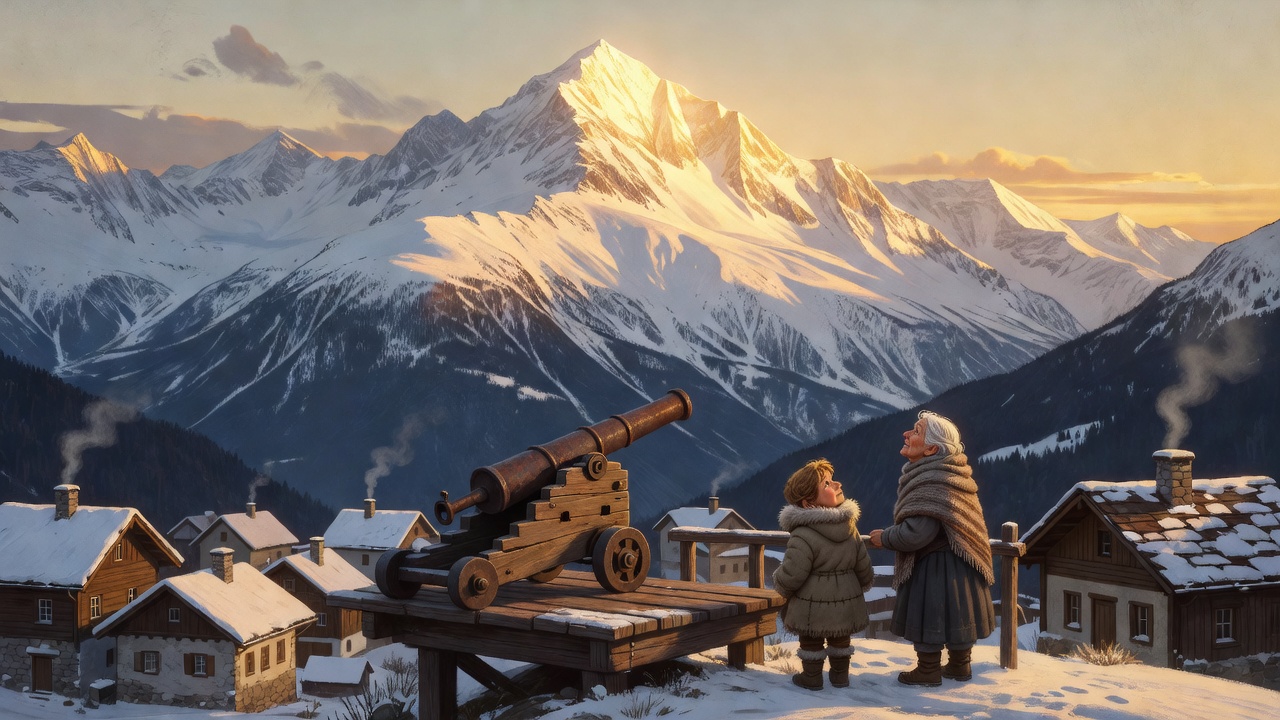
She had fired it for forty-one winters. Before her, her own dad had fired it, and before him a man named Tobiah Snell, who built the wooden platform the gun still sat on, up above the village where the road bent toward Bell Pass. There had always been a Carrow on the platform, near enough. And there was going to go on being one, because I had worked it out, lying in bed counting booms, the way you work out the only thing that has ever made complete sense to you.
It was going to be me.
I started getting ready to be chosen when I was nine.
By eleven I could read a snow pit better than most of the weekend volunteers. Gran took me up the study slope behind the school — the one we kept fenced, where nobody skied, so we could dig into it and see what the mountain was hiding. You cut a clean wall straight down through the snow, and then you read it like the pages of a book that has been rained on and frozen and snowed on again all winter. There were good layers, hard and grippy. And there were bad layers — the sugar snow, the stuff that looks like spilled salt, that won't hold the weight of everything piled on top.
"What've we got, Wren?" Gran would say, sitting back on her heels with her pencil behind her ear.
And I'd lean in close to the wall, and I'd brush it with my mitten, and I'd find it. The weak layer. The whisper of salt-snow buried three feet down, holding up a whole winter on its shoulders, just waiting for one more snowfall to be the last straw.
"There," I'd say. "Right there. That's the one that'll go."
And Gran would nod, slow, and write it in her little water-warped notebook, and I'd feel about ten feet tall. Because that was the gift, see. That was the thing that made you a Carrow. You could hear what the mountain was about to do before it did it. Everyone else just woke up to the boom and buttered their bread. I was going to be the one who fired it.
I had even started practicing my face for it. The not-blinking face. The face you make when you're so used to power that it doesn't even tickle you anymore.
I was working hard on that face the morning everything went wrong, which I suppose was the mountain's idea of a joke.
It had snowed for three days straight. Not the nice fat flakes — the small, fast, mean kind, the kind that piles up quietly and doesn't announce itself. Gran hadn't fired the gun in those three days, because you can't blast a slope you can't see; you'd just be guessing, and guessing was the one thing she said would get somebody killed. So all that new snow had been stacking up on the Horn, layer on layer on layer, sitting on the salt-snow underneath, and the whole back bowl was loaded now. I'd heard her say it on the phone the night before, in the low careful voice she used for mountain talk.
"It's right at the edge, Margaret," she'd said. "First clear hour, I bring it down. We keep the pass shut till I do."
So I knew, when I woke up to actual sunlight for the first time in days, that this was the morning. I pulled on everything I owned and ran up the lane to the platform with my breath smoking out in front of me, ready to watch Gran fire the loaded mountain, and maybe — maybe — ready for her to finally say it. Your turn soon, Wren. You're ready.
But Gran wasn't on the platform.
There were two men I didn't know, in matching blue coats with a logo on the chest, and a van, and a great deal of equipment in silver cases. And there was a thing on the platform where the gun should have been — a sleek white pole with a fat nozzle on top, pointed up at the Horn like a finger. The old gun, Tobiah Snell's gun, was sitting off to the side on the snow with a tarp half over it, looking like a thing that had been put out for the bin.
Gran stood by the railing with her arms crossed. She didn't look like a person about to fire anything. She looked like a person at a funeral who's determined not to cry at it.
"Wren," she said. "You're up early."
"What's that?" I said. I pointed at the white pole. My voice came out wrong.
One of the blue-coat men answered, all cheerful. "That, young lady, is a Remote Avalanche Control System. Gas-fired. It sits up here all winter, and we fire it from a laptop in town — no need to send anybody up the mountain in a storm at all." He patted it like a dog. "Whole valley's getting one. Hooked into the weather station. Eventually it'll fire itself, when the sensors say the load's too high. Clever, isn't it?"
"It fires itself," I said.
"That's the dream," said the man.
I looked at Gran. I waited for her to tell him that you can't let a laptop decide when to bring a mountain down, that you have to dig the pit and brush the wall with your mitten and find the salt-snow with your own hand. I waited for her to tell him about the gift.
She didn't. She just looked very tired, and very old, in a way I had decided years ago she wasn't allowed to be.
"Come on," she said to me. "Walk me down. They don't need me up here."
We went down the lane and she told me, in the flat voice, the whole thing. The council had voted. The new system was safer — that part she said like it cost her something, because it was true, and Gran never lied, not even to make herself feel better. No more sending an old woman up a platform in the dark. No more somebody has to do it. The machine would watch the load, and the machine would fire, and nobody would ever again have to be the one with their hand on the rope when the whole back of the Horn came down.
"But the gun," I said. "Somebody has to fire the gun."
"Not anymore, lovey."
"But — me. I was going to —" And I couldn't finish it, because saying it out loud made it sound like exactly what it was, which was a little kid's daydream, and I was suddenly furious at myself for ever practicing the face.
Gran stopped walking. She looked at me for a long moment.
"There was never going to be a gun for you to fire, Wren," she said, gently, which was worse than if she'd said it any other way. "I was the last. I knew it for years. I should have told you."
"You said I had the gift," I said. "The Carrow gift. Hearing it before it goes."
And Gran did something I'll never forget for as long as I live. She laughed — not a mean laugh, a sad, surprised, fond one, like I'd handed her something she'd lost a long time ago.
"Oh, my heart," she said. "There's no gift. There never was a gift. There's just — paying attention. You dig the pit. You brush the wall. You look at the layer everybody else walks over, and you don't look away from it. That's all it ever was. That's all I ever was." She squeezed my shoulder. "Anybody who bothers to learn it can do it. You just happen to be the only person under fifty who's ever bothered."
I didn't want to hear that. I wanted to hear that I was special. I walked the rest of the way down with my jaw set and my eyes hot, and I didn't say goodbye when she went into her house. I thought, with the whole furious force of an eleven-year-old who has just lost the one thing she was for, that I'd never go up that platform again.
Which is when I heard the bus.
You learn the sounds of Snowfield without trying. The milk lorry. The plough. The school bus that came up from the valley towns three days a week, with the kids from the farms too far out to walk.
The school bus wasn't supposed to come up today. The pass was shut. Gran had said so — we keep the pass shut till I do — keep it shut until the loaded slope was brought down. But the snow had stopped, and the sun was out, and I think somebody in some office in the valley had looked out the window at the blue sky and thought, well, that's all over then, and opened the road. They didn't know about the salt-snow three feet down on the back of the Horn. Why would they? You can't see it from an office.
I could hear the bus grinding up the lower switchbacks, the diesel labouring. In about four minutes it would come around the long bend below Bell Pass — the bend that runs right under the bottom of the Horn's back bowl. Right under all that loaded snow.
And the new white machine on the platform wasn't going to fire. I knew it wasn't, because I'd heard the blue-coat man say it — eventually it'll fire itself, when the sensors say so — eventually, not yet, not today; today it was just sitting there waiting to be told from a laptop in a town twenty minutes away, by men who were probably still drinking their coffee and didn't know the bus was on the road either.
Nobody was going to bring the mountain down. And the mountain didn't need bringing down by anybody — that was the awful thing — it was ready to come down all on its own, the second something shook it loose. The bus. The bus would shake it loose. The diesel rumble, or the weight, or just bad luck.
I stood in the lane with my breath gone solid in my chest, and I understood the whole shape of it at once, the way you understand the weak layer when your mitten finds it.
There wasn't time to run for Gran. There wasn't time to run for the blue-coat men, who'd taken the van down to town for more silver cases. There was only me, and the platform, and the old gun under its tarp.
Here's the thing nobody tells you about being brave. It doesn't feel brave. It feels like being the only one left who knows where the salt-snow is.
I ran. Not toward Gran. Up. Up the lane, up the steps to the platform, my lungs burning, and I yanked the tarp off Tobiah Snell's gun, and I stood in front of it, and for one cold second I didn't know what to do at all, because I had never actually fired it. I'd only ever watched. I'd practiced the face. I hadn't practiced the hands.
But I had watched for two years. And watching, when you do it properly, when you brush the wall with your mitten and don't look away — watching is a kind of practicing nobody gives you credit for.
The gun was old and simple, which was the only reason in the world I had a chance. It wasn't a real artillery cannon — Gran had explained it to me a hundred times, the way you explain a thing to a kid you're sure will need to know it someday. It was a launcher. You loaded the charge — a thing like a heavy steel pinecone, kept in the green ammunition box bolted to the platform, padlocked, the key on a nail under the rail because Gran said a key you can't find in the dark is no key at all. I knew where the key was. Of course I knew where the key was. I'd been getting ready to be chosen for two years.
I got the box open. I got the charge — heavier than I expected, both hands, careful, careful, you don't drop it. I lined the gun the way I'd watched her line it every clear morning I ever ran up here to watch, the back left corner of the Horn's bowl where the salt-snow ran shallowest and the slide would peel off cleanest and run down the safe gully, away from the pass, away from the bend, away from the bus.
I could hear the bus on the second switchback now.
I sighted along the barrel. I found the corner of the bowl. And I heard Gran's voice in my head, not telling me I was special, not telling me I was chosen — telling me the dull, careful, unglamorous thing she told me every single time, the thing I'd rolled my eyes at:
Check your line. Check it again. Then check who's below.
I checked my line. I checked it again. I leaned out over the rail and I looked down the long throat of the gully where the snow would run, all the way down, to make absolutely sure there was nobody in it — no skier, no plough, no kid sledding where they shouldn't. There was nobody.
There was nobody below.
I fired the gun.
The boom went through me like a hand closing around my whole body. I had heard it a thousand times from my warm bed, but I had never been inside it, never had it come up through the wooden platform and into my boots and my teeth. The charge sailed up — I actually saw it, a dark speck against all that white — and it came down in the back left corner of the bowl exactly where I'd put it, and it went off with a sound like the sky tearing.
And then the long, scraping hush. The mountain pulling in its breath.
I had got the first bang. Now I needed the bang after the bang.
For one whole second, nothing happened, and that second was the longest of my entire life, because if the slope didn't let go, then I'd done it for nothing, and the bus was coming around the bend, and the loaded snow was still up there waiting for the diesel rumble to be the last straw.
Then the back of the Horn moved.
It didn't crack or crash, not at first. It settled — the whole top of the bowl sort of sagged, like a cake when you open the oven too soon — and then a line appeared across the snow, a clean dark crown line right where the salt-snow had been holding up the whole winter on its shoulders, and the entire slab let go at once and came down. Not toward the pass. Not toward the bend. Down the safe gully, exactly where Gran had always aimed it, a roaring white river of it, throwing up a cloud that rolled and bloomed and caught the morning sun gold at the top.
The bus came around the bend below.
It came around the bend, in the clear, with all that snow already down and harmless in the gully beside it, the driver lifting one hand off the wheel to shield his eyes against the bright cloud, having no idea in the world that anything had nearly happened at all.
That's the thing about the careful work. When you do it right, nobody ever knows there was anything to be careful about.
Gran found me sitting on the platform with my back against the old gun and my legs shaking too hard to stand on. She must have heard the boom and known — known instantly, the way she knew everything — that it had come from the wrong gun, the dead gun, the one that wasn't supposed to fire ever again.
She didn't shout. She didn't grab me. She came up the steps slowly and she looked at the gully, still smoking with snow-dust, and she looked at the bus disappearing safe up the road, and she looked at the green ammunition box hanging open, and the key on its nail, and the gun, and me.
And then she sat down on the cold platform next to me, this old woman in her good coat, right down on the boards, and she put her arm around me, and for a while neither of us said anything at all.
"The pass was open," I said, finally. My voice was still wrong. "The bus. Nobody knew about the salt-snow on the back. Nobody was going to fire it. The machine — it doesn't fire itself yet, the man said. I heard him say —"
"I know," said Gran. "I know, lovey."
"I checked my line," I said, and then, because it was suddenly the most important thing in the world that she know I had done it properly, that I hadn't just been a reckless kid playing with a gun, "I checked it twice. I looked down the whole gully first. There was nobody below. I checked."
Gran was quiet for a moment.
"You checked," she said.
"I did everything you said."
"Yes," she said. "You did." And her voice did something then, went thick and careful, and I realised she was the one not blinking now, working hard at the not-blinking face, and not quite managing it. "You did everything I said."
They never did give me the gun, because there was no gun to give. The new white machine stayed up on the platform, and a week later the sensors got hooked into the weather station, and now it does fire itself, more or less, when the load gets too high. It's safer. Gran was right about that, the way she was right about everything. No old woman has to climb the platform in the dark anymore. No kid, either.
But here's what I worked out, that winter, sitting against the dead gun with my legs still shaking and my gran's arm around me and a busload of kids riding home safe without ever knowing my name.
I'd had the whole thing backwards. I thought being a Carrow meant being chosen — that there was a gift in me, a special thing, and one day the mountain would tap me on the shoulder and the gun would be mine and everyone would finally see how special I was. That's why I practiced the face. The face was for being seen.
But nobody saw me fire that gun. The bus driver didn't. The kids on the bus didn't. The men in the blue coats came back and never even knew. The only person who ever knew was Gran, and she only knew because she heard the wrong gun go off.
And it was still the best thing I have ever done.
So it was never about being chosen. It was about being the one who bothered. The one who dug the pit and brushed the wall and looked at the layer everybody else walks right over. The one who checked her line, and then checked it again, and then checked who was below.
Anybody who bothers to learn it can do it, Gran said.
I intend to be the one who bothers. For the rest of my life, on this mountain, I intend to be the one who bothers — and I do not need a gun, or a gift, or anybody's face turned toward me to be it.
I still blink at the dawn boom, though. Every single time.
I count, too. One whump for the machine. Then the long scraping hush. Then the second sound, softer, bigger, further off — the snow letting go down the safe side, the way it's supposed to.
The bang, and the bang after the bang.
You have to get both. If you only get the first one, something's still up there, waiting.
And I'm the kind of person, now, who will go and find out what.
Enjoyed this story?
Read next
 A nineteen-year-old Cobb is caught with the dock-workers' burial fund and will not say one word in his own defence — and the silence everyone has read as guilt is in fact the only act of love his family has left, and the one thing standing between the boy and the truth.
The Burial Fund
 The spectrometer said the wine was a forgery, the master of wine agreed, and a man's life was to be ended over a bottle — and not one of them had thought to ask the only question that matters about a fake, which is who it was made to please.
A Question of Vintage
 They had her on three cameras, her phone, and a swipe card, which in the modern view is the same as having a confession — and which proves only that the machine saw exactly what she did, and understood nothing whatever about why.