
The Long Draw
Content notes
a drowned child (non-graphic), grief, generational loss
Once in a hundred years the Sillow draws all the way back.
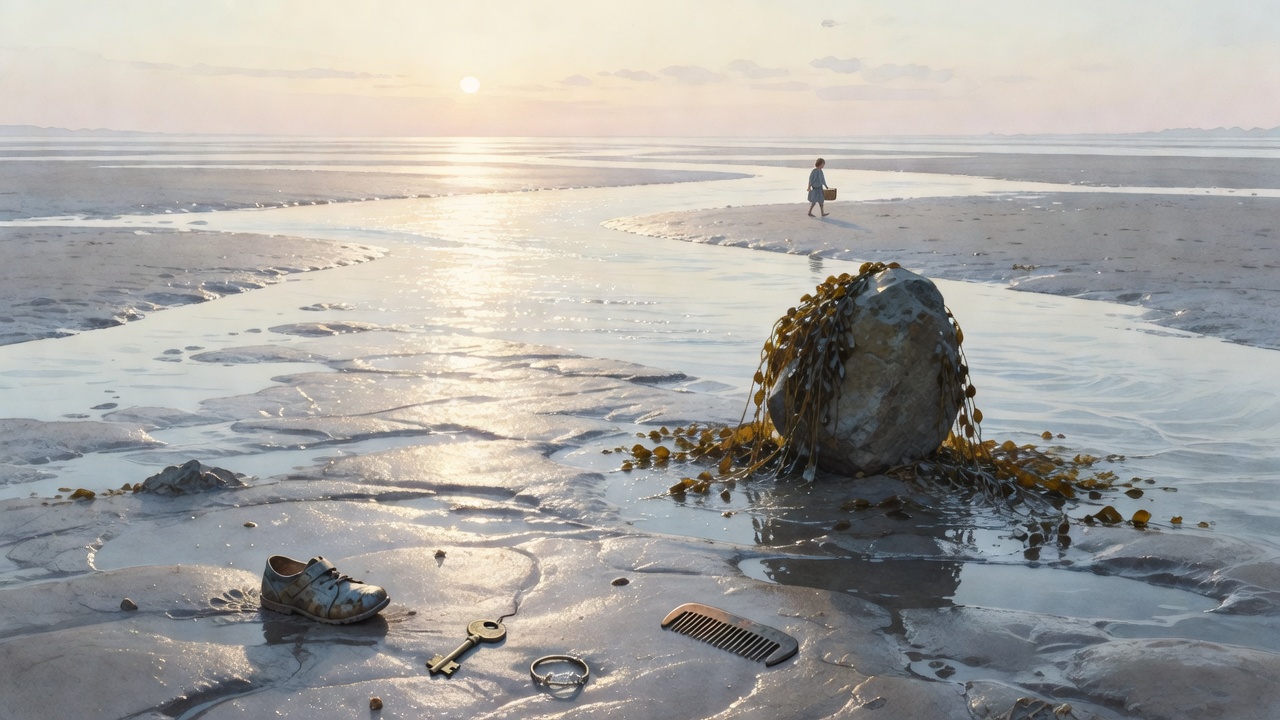
Not the way it goes out every day, leaving the near mud bare for the gulls and for me. That's only the river breathing. No — once in a hundred years it draws back so far that the channel itself goes thin as a hair away on the horizon, and the whole bed of it lies open to the sky, mile on mile of grey-silver mud that no living person has walked, and laid out across that mud, salt-bright in the dawn, is every single thing the river has ever taken and not given back.
We call it the Long Draw. There has been one before in living memory, and there won't be another, and on the morning it came I was the only soul in Saltmere who walked out onto the flats glad.
I had better tell you why a person would be glad, because it isn't a glad thing, and if you think it is, you haven't understood it yet.
My family is a thin-yeared family. That's the village word, and the village is careful with it, the way you're careful with a word for a thing you're afraid might be catching.
It means this. Every third generation, the river takes one of us. Not drowns — takes. There's a difference, and everyone on the Sillow knows it, and no one will say it to your face. A drowning is loud and wet and over, and the body comes back bloated and blue and is buried with a stone. A taking is quiet. A taking is a girl who walks down to the water in good weather, in plain view, with no reason in the world, and steps in, and goes under, and is simply not there anymore — and the river doesn't give the body back, not bloated, not blue, not ever, because the river didn't drown her. The river kept her.
The last one of us the river kept was a girl named Ailie, more than a hundred years gone, before my grandmother's grandmother was grown. She was the elder sister of my grandmother's grandmother — Edda, the only name in that part of the story the family ever kept. Ailie was nine. She had a green wool coat and one front tooth gone and she walked into the Sillow on a calm bright morning while Edda, who was seven, watched from the doorstep and couldn't move, the way you can't move in the worst dreams, and the water closed over the green coat and that was all. I have this the way I have everything from that far back — handed down, worn smooth, told and told until you can't find the teller's hand on it anymore.
That's what it is to be thin-yeared. You go through your life knowing the river holds a marker against your blood, and that it'll be called in, in its own time, three generations to a draught, and there's nothing — the priests have tried, the wise women have tried, my grandmother's grandmother tried — nothing anyone can do.
Except.
Except that once in a hundred years the river draws all the way back, and lays everything out, and the old law of the Long Draw says that a person of a thin-yeared line may walk out across the open bed and find what was taken from their blood, and pick it up, and carry it home, and keep it.
Keep it. Have it back. The green coat and the gone tooth and the whole of Ailie, nine years old forever, restored out of the mud and walking up the bank holding your hand. The river won't stop you. That's the law of the Draw, plain as anything: what it took, on this one morning, it must suffer you to take back, if you can find it and you're brave enough to carry it.
Edda walked out at the last Long Draw to bring Ailie home.
And she came back across the flats empty-handed, with the tide already turning at her heels, and she never said why — not to her own daughter, not to anyone who came after, not on the night she died, so the story says, and the story is all I have. The village had its own answer ready, the way villages do, and it has had a hundred years to harden. They said Edda Sael had walked out to the very edge of mercy and found she had no nerve for it. They said she got close enough to see her sister's small kept face and couldn't make her hands do the last brave thing, and so she came home and left a child in the river out of plain cowardice, and that's why the thinness still runs in us, uncut, unpaid, waiting — because the one chance in a hundred years to break it, Edda flinched from.
I grew up under that. The cold-hearted Saels, who left their own in the water. Edda went to her grave the woman who wouldn't, four generations before me, and four generations of us have carried it since.
So you see why I was glad. I was thirty-one, and the Draw had come round again — a hundred years on from Edda's, fallen by chance into my own short life, which is a thing that almost never lands twice on the same blood with someone left who can walk it — and I was a mudlark by trade, the best on the Sillow, which is a thing I'll tell you about because it's the whole of how I came to understand. I had spent my life learning to read what the river gives up. And I was going to walk out across that open bed and find Ailie, and I was going to carry her home, and I was going to undo a hundred years of being the family that wouldn't.
I was going to be the one who did.
Here's what mudlarking is, properly done, so you'll believe the rest.
Anyone can stoop on the foreshore and pocket a bit of old clay pipe. That isn't the craft. The craft is reading. You take a thing the river has surrendered — a buckle, a thimble, a child's tin soldier with the paint gone — and you hold it, and you let the river tell you the life it came out of. It's in the wear. It's in the way the salt has eaten one side and spared the other, which tells you how it lay all those years, which tells you how it fell, which tells you, if you're patient and you have given your whole life to the listening, who let it fall, and why, and what they were thinking as it went.
I can hold a wedding ring worn thin as wire on the inside and worn nothing on the out, and tell you it was a poor woman's, kept for love and not for show, taken off only to scrub and put on again wet, forty years of it, and that she didn't lose it in the river — that she stood on the bank and worked it off her swollen knuckle on purpose and dropped it in, the autumn after he died, because she couldn't bear it warm on her hand and couldn't bear it cold in a drawer, and the river was the only thing big enough to give it to.
The river tells me. Or I tell me, by reading the river. After a while you stop being able to say which, and you stop wanting to.
That's the craft. It's a slow and a loving thing, and it doesn't make you rich, and it has made me, I think, more company to the dead of the Sillow than to the living of Saltmere, and on the morning of the Long Draw it was the craft, in the end, that I couldn't put down, even when putting it down was the one thing that would have let me do what I came to do.
The flats at the Draw were like nothing I'll see again.
Imagine the river simply gone — not dry, never dry, but withdrawn, the whole vast bed of it lying open and shining and breathing its cold low breath up at the pearl-grey sky. And everywhere, as far as I could see, the things. Not heaped. Laid. Each one set out a little apart from the next in the mud as though by a careful hand, which I came to think it was. A brass key. A pewter cup. A doll with a china face and the body rotted to nothing. A wedding band. A spectacle frame. A boot, a single boot, always a single boot, because the river is a great keeper of single boots. A hundred years of the taken Sillow, and behind every object a person to whom it was the whole world, and I, who read such things for a trade, walked out into the middle of all that grief laid bare and felt my craft rise up in me like a tide of its own.
I could have stayed out there a year and read every soul of it.
But the Draw doesn't give you a year. The Draw gives you the slack of the lowest water, and then the river turns and comes back, and it comes back fast, faster than a person can run on mud, and so I had been counting since I stepped off the bank. I had perhaps four hours. I went out toward the thin far gleam of the channel, where the oldest things would lie, because Ailie had been taken more than a hundred years gone, when Edda was a child, and the river sets its keepings deep.
And as I went I read, because I couldn't help it. That's the first thing you should understand about how it went wrong. I didn't stride out single-minded to my one purpose like a woman in a story. I'm a reader. I read all the way out. I couldn't pass a thing and not know it.
There's a stone in the bed of the Sillow that's only uncovered at the Long Draw.
I had heard of it the way you hear of everything that comes round once a century — as a rumour shaped like a fact. The tallystone, the old people called it. They said the river keeps its count on it. They said it stood out in the deep channel where no one goes, and that on the morning of the Draw you'd find it, and that you should leave it be.
I found it three hours out, at the lip of the thin channel, with the far water muttering beyond it, and it wasn't muttering rumour, it was a stone — a single standing stone the height of a man, black where the others were grey, wrapped about its base in bladderwrack like a green skirt, and worn all over its faces with marks.
I'm a reader of marks. I couldn't not read it.
They were tallies. Not letters — strokes, scored deep, in groups, the way you keep a count of days in a cell or a debt on a slate. And they were grouped in threes. Three strokes, a space. Three strokes, a space. All down the standing stone, hundreds of them, generation on generation, and I stood there with the cold coming up through my boots and read what the river had been writing for longer than Saltmere had a name, and I understood the thing the village had got wrong for a hundred years, and the understanding went into me like the cold, from the feet up.
Here's what the stone said, and I'll say it plainly, because the river didn't say it plainly to me and I wouldn't wish the slow way on anyone.
The thinness isn't a curse. It's a debt, and a debt has two sides, and we had only ever stood on one of them.
I had always thought — we all thought — that the river took, and that the Long Draw was its one grudging mercy, the one chance to take back. As though we were robbed, and once in a hundred years the thief left the door open.
But the strokes on the stone weren't a record of takings. I read them and read them, and I have read enough wear to know a ledger from a tombstone. A tombstone counts the lost. A ledger counts what's owed and what's paid. And these were grouped in threes — three generations to a draught — and at the foot of each group of three, where the count came due, there was a fourth mark, set apart. And in some of the groups that fourth mark was scored deep and closed, a thing settled. And in others it was scored once and left open, a thing still hanging.
And I read, in the wear of it, in the salt-eaten depth of the strokes, the shape of what the fourth mark meant. It was the Draw-mark. It was the mark of what a thin-yeared person did, when their hundred years came round and they walked out across the bed to this stone.
If they took back what was taken — if they found their kept child and carried it home, and kept it — the fourth mark was left open. Open, because the debt wasn't closed. Open, because keeping is taking, and you can't pay a debt by taking more. To carry Ailie home would be to put my own name to the open mark, to sign for another draught, three more generations, one more kept child somewhere down my line — a daughter or a granddaughter who would walk into the calm bright water while someone watched from a doorstep and couldn't move.
And if they refused — if they walked all the way out, all the way to the stone and the lip of the cold channel, close enough to see the small kept face, and then turned, and went home across the turning mud with their hands empty and their heart broken open and their whole village ready to call them coward — the fourth mark was scored deep, and closed. Settled. Paid. Because the river's debt isn't for blood. The river doesn't want the child. The river wants the refusal. The river wants to be told no by the one person in the world who has every reason in heaven to say yes, and that no, that one impossible no, is the only coin that closes the account.
Edda's mark was on that stone. I found it. A hundred years of salt hadn't been kind to it but I'm a reader and I read it and it was scored deep, and it was closed.
Edda Sael hadn't flinched.
I sat down in the mud beside the tallystone, three hours and more out into the open bed of the Sillow, with the channel muttering its return at my back, and for the first time in my life I understood Edda — a woman a hundred years dead, whom I knew only as a name and a disgrace, suddenly as near to me as my own cold hands — and it was unbearable.
She had walked out here at seven decades old. She had walked out across this same bed to bring her sister home — Ailie, nine years old, the green coat, the gone tooth, the face that had gone under while seven-year-old Edda watched and couldn't move. She had wanted it, my foremother, the way I wanted it, with the whole of her. And she had got all the way out here, all the way to this stone, and she had read it — or the river had told her, the slow way, the cruel way, with the face right there to look at — that to carry Ailie home was to hand the river another Sael. That the love that reached down to lift her sister out of the cold was the exact same motion that pushed an unborn girl in.
And she had taken her hands back. She had left her sister in the river a second time, on purpose, knowing — and that, that taking-back of the hands, was so much harder and so much braver and so much more loving than any rescue that I don't have the craft to read the bottom of it.
And she had walked home and let them call her the woman who wouldn't. She could have told them. She could have come up the bank and said, I closed the debt, I paid it, none of your daughters will be taken now, I bought you free with the only coin the river would take from me — and they'd have made her a saint. Instead she let them make her a coward, for the rest of her life and on into her grave, because — and this is the part I sat in the mud and wept over, with the river coming back — because the telling would have been a kind of keeping too. The telling would have been her reaching back out of the water to take something for herself: her good name. Her place in the story. She wouldn't even keep that. She paid the whole debt, the child and the credit both, and asked for nothing back, not even to be remembered kindly, and she's in the cold ground now under a stone that the village walks past without softening, and she was the best of us, and no one will ever know it but me.
I want to tell you that I knew at once what I'd do.
I didn't. I sat by the tallystone for the better part of an hour I didn't have, while the channel filled at my back, and I argued it like a lawyer and I begged it like a child.
Because Ailie was right there. I could see her. A century out and deep, the river had set her near the channel, and the Draw had laid her out like all the rest — not a body, you understand, not bones, that isn't how the river keeps; the river keeps the way it kept the wedding ring, in a thing. There was a green coat folded small on the mud, child-sized, the wool sound as the day it went under, and one small shoe set beside it, a single shoe, the way the river always leaves a single shoe, and I held the coat — I couldn't help it, I'm a reader — and the whole of her came up into my hands the way the lives always do. The low start of a laugh. The gap where the tooth had been. The thing she had been thinking on the calm bright morning, which wasn't sadness, which was the river telling her a wonder, the river being, to a nine-year-old at the edge of the water, the most beautiful and inviting thing in the whole world. She hadn't been afraid. That's what the coat told me. She had gone in toward something marvellous. They always do. That's how the river takes.
And I knelt there holding a kept child in a folded coat, the lost girl of ours I had grieved my whole life without ever having met, and all I had to do to bring her home — warm, laughing, gap-toothed, mine — was stand up and carry her, and the river by its own law would let me.
And down my own line, in a year I'd never see, a girl I'd never meet would walk smiling into calm bright water toward something marvellous, and someone would watch from a doorstep and not be able to move.
The river came back while I knelt there. I had counted wrong, or I hadn't wanted to count. The slack was over. I felt the change before I saw it — the mud beneath my knees going from firm to a thing that breathed, the cold edge of the first returning water finding the channel's lip and brimming it. The far gleam wasn't far now. The Sillow was coming home to its bed, and it doesn't wait, and it doesn't care, and if I knelt there much longer arguing with myself it would take the decision out of my hands by taking me, and I'd be a new mark on the stone, and an open one.
I stood up.
I'm not going to pretend it was a clean thing or a noble thing or that I did it the way Edda did it, out of a love so total it could let go. I want to be honest, because she was honest, even when honesty cost her her name. I stood up and I almost kept her. My hands had decided to keep her before my heart had finished arguing. I had the coat against my chest and I had turned three steps toward home with it before the cold came up over my boots and I thought, not of the unborn girl, I'm ashamed to say, but of Edda standing exactly here, exactly this far, with exactly this much weight in her arms, and turning back. And I couldn't be less than her. That was the whole of it, at the end. Not goodness. I couldn't walk up that bank having done the easy loving thing Edda had been too good to do, and let her be the coward in the story while I was the hero, when I knew, alone of all the world, that it was the other way round.
So I knelt one more time, with the water at my heels, and I laid the green coat back down on the mud, and the single shoe beside it, the way the river had laid them, and I read her one last time so that someone would have, so that the whole of Ailie would have been known once more before the water closed over her a second time — the laugh, the tooth, the wonder she went toward, none of it wasted, all of it held in a pair of hands for one more minute in a hundred years — and then I took my hands away.
That's the thing the village will never have a word for, the taking-away of the hands. It isn't a flinch. A flinch is fast. This was the slowest thing I have ever done. I took my hands away from a child I loved, on purpose, knowing, while the cold water rose, and it was the cruelest thing I'll ever do and it was the most loving thing I'll ever do and it was, the river taught me, the same thing. There's only the one gesture. I had spent my whole life thinking love and refusal were opposite directions, and the river drew all the way back once in a hundred years to show me they're the same hand, opening.
There's a custom at the tallystone that the old people only half remembered, and I think I'm the first in a hundred years to keep it, because I'm the first in a hundred years to read it off the stone itself, scored small at the foot among the tallies: that the one who pays may leave a thing on the stone for the Steward of the channel — the keeper of the deep water, the one whose careful hand lays the taken things out in their rows, whom no living person has ever seen and no one ever will, because the Steward keeps the deep and the mudlark keeps the flats and the two of us were never made to meet.
I had nothing to leave but my reading-glass, the little worn lens I had read ten thousand drowned lives through, and so I left that, balanced in a cleft of the black stone above the rising water, a craftswoman's whole trade given to the dark, for the one who lays out the grief so carefully each hundred years that I had mistaken its careful rows for cruelty.
And then I ran. You can outrun the Sillow at the very turn of the Draw if you go at once and you don't look back, and I went at once, and I didn't look back, and I came up the bank into Saltmere with the water roaring in behind me to fill its bed for another hundred years, and my hands were empty.
They're saying it already. I came home empty-handed from the Long Draw, the way Edda did a hundred years before me, and the village has its answer ready, the way villages do. Another Sael who walked out to the edge of mercy and had no nerve for it. Another cold one who left her own in the water. The thin-yeared family, thin again, uncut, unpaid — when everyone knows that if you only had the heart, the Draw is the one chance to break it.
I could tell them. I think about it. I stand at Edda's stone, that no one softens for, a hundred years' worth of nobody softening for it, and I think how easy it would be to say the true thing and be made a saint beside her at last, the two brave Saels who paid the debt, and have it carved deep where the village walks.
But that would be a keeping. That would be my hand reaching back out of the cold to take one thing for myself, and I have learned, out there by the tallystone, what every keeping costs and who it falls on. The debt is closed. I won't open it again for the price of being thought kind.
So I keep Edda's silence the way she kept it, which I understand now was never silence at all but the last and best of the payments — and I keep this account instead, here, where no one in Saltmere will read it, so that the thing is on the record somewhere, and not only true tonight: that we weren't the family that wouldn't.
We were the family that wouldn't keep.
It's the same word. It's the same hand. Once in a hundred years the river draws all the way back to teach you that, and you walk home across the turning mud knowing it, and the water comes in behind you and fills its bed, and the green coat folds itself small in the dark again, and somewhere a girl who will never be born doesn't walk smiling into calm bright water toward something marvellous — and there's no one on the bank to thank you, and there never will be, and that, the river taught me, is how you know it was love.
Enjoyed this story?
Read next
 A nineteen-year-old Cobb is caught with the dock-workers' burial fund and will not say one word in his own defence — and the silence everyone has read as guilt is in fact the only act of love his family has left, and the one thing standing between the boy and the truth.
The Burial Fund
 The spectrometer said the wine was a forgery, the master of wine agreed, and a man's life was to be ended over a bottle — and not one of them had thought to ask the only question that matters about a fake, which is who it was made to please.
A Question of Vintage
 They had her on three cameras, her phone, and a swipe card, which in the modern view is the same as having a confession — and which proves only that the machine saw exactly what she did, and understood nothing whatever about why.